

Blog: 10 Common Myths About Dehumidifiers Debunked
10 Common Myths About Dehumidifiers Debunked
Before I bought my first home, I spent many years living in damp rented houses. Often the solution provided by the landlord would be to install a dehumidifier before addressing any structural issues with the property. While they work perfectly well for removing condensation on windows and getting rid of musty odours, they are most certainly not a silver bullet.
A dehumidifier is only as effective as the logic behind its placement, or the understanding of moisture loads. Homeowners often make the mistake of setting a dehumidifier and then forgetting about it, assuming that the problem now is as good as fixed. However, mismanaging your indoor relative humidity (RH) not only wastes energy, but can also lead to costly structural damage further down the line.
I suppose the problem here is that dehumidifiers are often shrouded in myths. Some users deploy a small portable unit in a foolish attempt to dry out a whole flooded basement, while others assume they are only really necessary during the peak of summer humidity.
In this guide, I will be debunking the 10 most common dehumidifier myths, drawing on HVAC industry standards and actual performance data to clear the air on what these systems actually do. We will be taking a closer look at how they interact with your home’s dew point, and how we set them up in the industry for maximum effect.
Key Takeaways:
A Tool, Not a Repair: Dehumidifiers do not fix structural issues such as leaking pipes or rising damp. Dehumidifiers are responsible for managing atmospheric vapour and the source of ingress should always be addressed first.
The Daily Vapour Load: Everyday activities such as showering, cooking, and even breathing will add 10–15 litres of moisture into your house a day. This moisture will be absorbed by your home if you do not remove it.
The Sweet Spot: You’ll be surprised when you discover humidity levels are higher than you expected them to be. If you aim for Relative Humidity (RH) around 45%–55% this is the ideal range to prevent moisture being trapped inside.
Match Tech to Temp: Compressor units are used for heated areas while desiccants are often the only method for treating cold, unheated spaces.
The Deep Dry Phase: Thorough drying will take anywhere from 7 to 14 days. At this stage you are no longer just drying the air, you are extracting moisture trapped deep down within the building's materials.
Myth #1: "Dehumidifiers Fix All Damp Issues”
What do you think, true or false? Yeah that one is a big old fib. Pretty sure my landlord even used that one on me too. It’s one of the biggest misconceptions, that a dehumidifier is some magical substitute for structural repair, unfortunately it’s not.
It’s true we use dehumidifiers to manage vapour pressure in the air, however, they cannot solve a problem caused by structural issues. To treat penetrating damp from leaking roofs for instance, a dehumidifier will help the issue, but it will not make it go away.
When Should I Use a Dehumidifier
You can often see and even smell when you should use a Dehumidifier. I advise looking for the tell tale signs such as moisture collecting on a window sill or a slight musty odour in the air.
Dehumidifiers are ideal for drying out timber or plaster. They’re also great for reducing moisture caused by everyday activities like showering and cooking.
Myth #2: “Dehumidifiers Are Only for Basements"
In reality moisture builds up anywhere and easily moves through a building’s thermal envelope.
The Science of Daily Vapour Production
Most modern homes are made airtight to improve energy efficiency, unfortunately this tightness traps in a lot of moisture that is created internally. For example, an average family of four will roughly produce 10 to 15 liters of moisture per day through everyday tasks.
For removing moisture build up in your home be sure to take a look at our Home Dehumidifiers category.
Practical Application:
- Cold Corners: In bedrooms, moisture often collects in corners where temperatures are lower. I can certainly remember mould growing behind wardrobes back when I was renting.
- Hygroscopic Storage: Tools stored in your garage or workshop are susceptible to rust if RH levels exceed 55%.
- The Greenhouse Effect: Moisture travels. If you don’t use a dehumidifier to capture it at the source, it will travel through your home affecting areas you thought were safe.
Myth #3: “You Only Need to Use A Dehumidifier During Summer”
The myth that completely ignores the science of the dew point, where the temperature can no longer hold water vapor, causing it to liquefy. You can bet that humidity will actually peak in winter, this is when air that is warm and moist hits a window and reaches its dew point instantly.
Why it matters in Winter
Removing excess moisture from the air during the winter months can actually lower your energy bills. As dry air has a lower heat capacity than moist air, your central heating will be able to work more efficiently, meaning it will spend less time switched on.
Moisture trapped inside cavity walls during the winter can be absolutely disastrous for your home's structural integrity. Prevent this hidden rot by strategically placing a dehumidifier close to these troublesome areas.
Myth #4: “Dehumidifiers Cleanse The Air”
There is a slight crossover here as both improve indoor air quality. Unfortunately, confusing the two will only lead to purchasing the wrong product for your specific needs.
The Distinction
To capture dust, particles and other allergens, Air purifiers use HEPA (High-Efficiency Particulate Air) or Activated Carbon filters. Whereas a refrigerant cycle or desiccant material is used by dehumidifiers to remove water from the air. A standard dehumidifier will not clear the air of dust or pollen.
We use dehumidifiers for controlling problems at the source. Because they absorb moisture from the air, dust mites for example cannot survive in environments where RH is below 50%. To stop mould spores from germinating, you will need to keep RH below 60%.
Myth #5: “Dehumidifiers are Too Noisy”
This myth is based on earlier models relying on heavy, vibrating pistons. Most modern units are much more streamlined inside with many being housed in shock absorbing cases.
At home, I use the Prem-I-Air EH1930 which operates at around 38 dB(A), which is well below normal conversation and probably just a little above your standard refrigerator hum.

What’s changed?
- Rotary Compressors: These are now featured on most modern units. They have fewer moving parts and produce less vibration found on much older models.
- Aerodynamic Fan Blades: These blades can move high volumes of air while creating minimal disturbance to reduce sound
- Induction Motors: Variable speeds help provide inaudible operation.
Myth #6: “Dehumidifiers Make The Air Too Dry”
Most modern units now feature integrated humidistats that would make it very difficult to over dry a room. One thing that I will guarantee is that once you start to monitor humidity levels in your home, you will be surprised to see how much they can fluctuate during normal daily activities.
When relative humidity stays between 40% and 60% you are optimising your space not only for comfort but for health too. Below 30% is normally when you start to experience dry skin or respiratory issues, above 60% is when you start to see mould growth or dust mites.
Most modern units now feature internal sensors to toggle the dehumidifier on and off once levels drop below the set threshold.
Myth #7: “Dehumidifiers All Use the Same Technology”
At first glance, most models look the same and this is most probably the reason behind everyone assuming that they all do the same thing. However, failing to know the difference between the technologies puts you at risk from purchasing the wrong dehumidifier.
While not always obvious from the outside, the following two systems operate in completely different ways.
Compressor vs. Desiccant
There are two main technologies used in dehumidifiers:
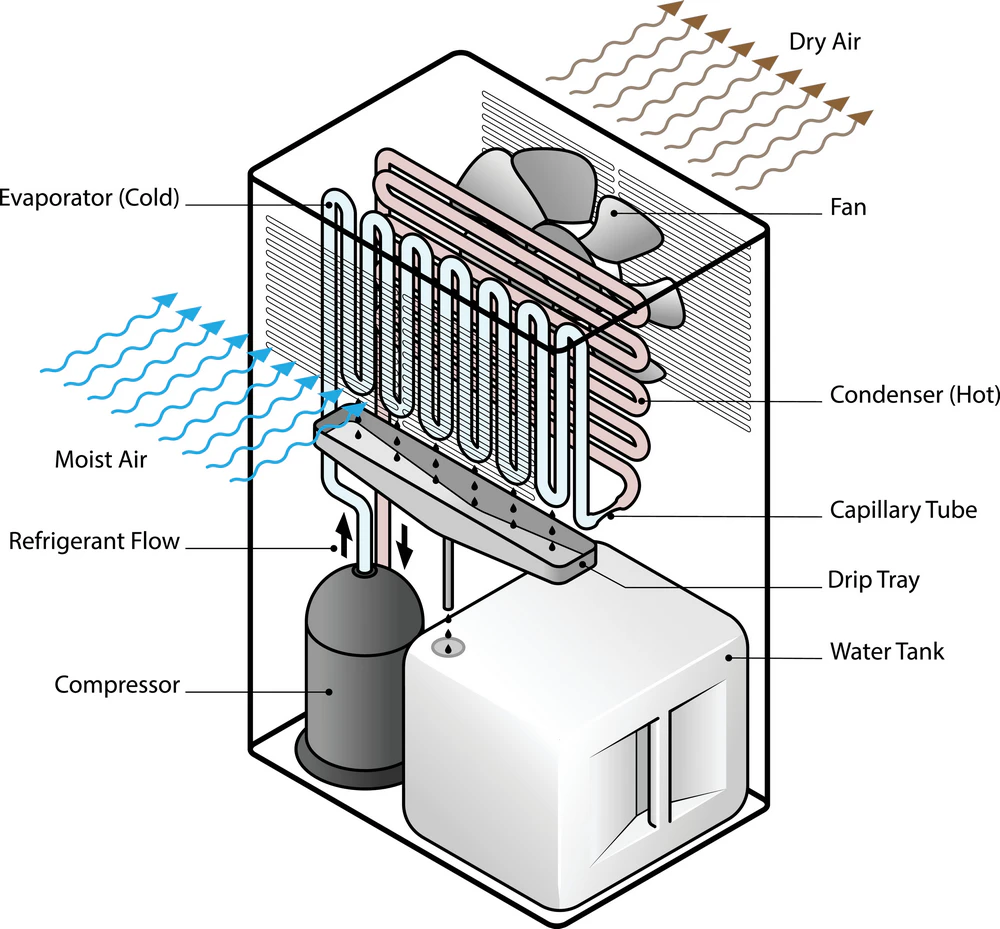
- Compressor Dehumidifiers: These draw moist air across a cooled coil and condense that air into water to collect it in the tank. These are the units you will often find in homes as they are more energy efficient and suitable for warmer spaces.
- Desiccant Dehumidifiers: To capture moisture from the air, these dehumidifiers use a special moisture absorbing material. They are more often than not the only practical solution in colder spaces. As their designs use a heating element, their energy usage is often higher as well.
To put this in real world context for you, placing a compressor unit in a cold garage where the temperature drops below 5°C, the coils will simply freeze over. Conversely, placing a desiccant model in a hot laundry room will only add unnecessary heat to that space.
Myth #8: “Dehumidifiers are Too Complicated to Use”
While understanding things like Psychrometric charts and the overall science of humidity can be complex, dehumidifiers themselves are relatively easy to operate. My Mum who is a self confessed technophobe has one in her kitchen and she has no trouble operating and emptying one.
Most modern units now feature digital thermostats which are far more accurate than old analog dials and remove a lot of guesswork.
Myth #9: “Dehumidifiers Waste Energy and Money”
I understand the cost to run dehumidifiers is a primary concern for most and one of the first questions I often get asked is how much electricity it will use.
However, by lowering the RH your central heating becomes more effective as dry air is easier to heat. Most modern compressor units can actually extract more litres of water per kilowatt-hour as they now use sustainable Refrigerants (like R290).
I would advise looking for a unit with an Automatic Laundry Mode function to dry clothes faster indoors. This will also prevent a moisture spike that typically causes winter mould.
Myth #10: “A Good Dehumidifier Dries the Air Instantly”
Dehumidification is a gradual process that will take time as you are not just drying the air, you are drying the fabric of the building. The big thing that surprises most people is that moisture isn’t just in the air, it is trapped in walls, floors, timber, carpets and soft furnishings.
The Timeline of Recovery:
- Hours 1–24: This is where you will see lots of water collected in the tank as the surface humidity is removed from the room.
- Days 2–7: During this deep dry phase extraction rates will slow down. The dehumidifier is now pulling moisture from deep down beneath structural materials.
- Maintenance Phase: Once the Equilibrium Moisture Content is reached, the unit now only needs to kick in periodically to manage new moisture.
Excess moisture indoors creates wider problems over time. I would recommend following the guidance from the NHS on mould in homes and how this can affect indoor air quality if not dealt with.
Conclusion
Dehumidifiers are often held back by outdated myths or with unrealistic expectations when it comes to performance. Hopefully this guide has given you a good grasp of the science and technology needed to yield good results when it comes to putting what you’ve learnt into practice.
If you now feel like you’re ready to take the next step in addressing excess humidity in your home or workplace, then what you need to do now is to match the right extraction capacity to your environment. Every building is unique so getting the right dehumidifier is crucial, please feel free to contact our technical team for expert advice in selecting the unit that is right for you.
Frequently Asked Questions About Dehumidifiers
Q: How long does it take for a dehumidifier to dry a room?
A: The length of time it takes is down to Equilibrium Moisture Content (EMC) of the materials found in the room you are drying. Within 12-24 hours you should see a reduction in surface moisture, such as condensation on window sills. However, it can take 7 to 14 days to extract moisture from deep inside porous materials like timber and carpets.
Q: What is the ideal humidity level for a home?
A: The most effective way to prevent mould growth and other undesirable effects of high humidity is to keep Relative Humidity (RH) around 45% to 55%. Most homeowners are often surprised when they learn how high their humidity levels really are.
Q: Should I run my dehumidifier 24/7?
A: You should during the initial phase. After this period units that feature an integrated humidistat will only draw power once the sensors detect a spike in vapour pressure meaning you can leave the unit switched on and ready to go.
Q: Can a dehumidifier stop mould from growing?
A: A dehumidifier will help prevent mould from growing but if you already have mould growing in your home you will need to remove this with a professional cleaner. Once removed, a dehumidifier will stop it from returning providing humidity does not cross the set threshold.
Q: What is the difference between compressor and desiccant dehumidifiers?
A: A compressor (or refrigerant) uses a refrigerant cycle to create a cold surface to trap and condense water. These are most often found in domestic spaces where temperatures are above 15°C. Desiccants (absorption) use a chemical attraction to pull water from the air. They are the only method of extraction in cold temperatures as low as 1°C.