


What is 3 Phase Power Supply And Do You Need It?
Date: 3 March 2025
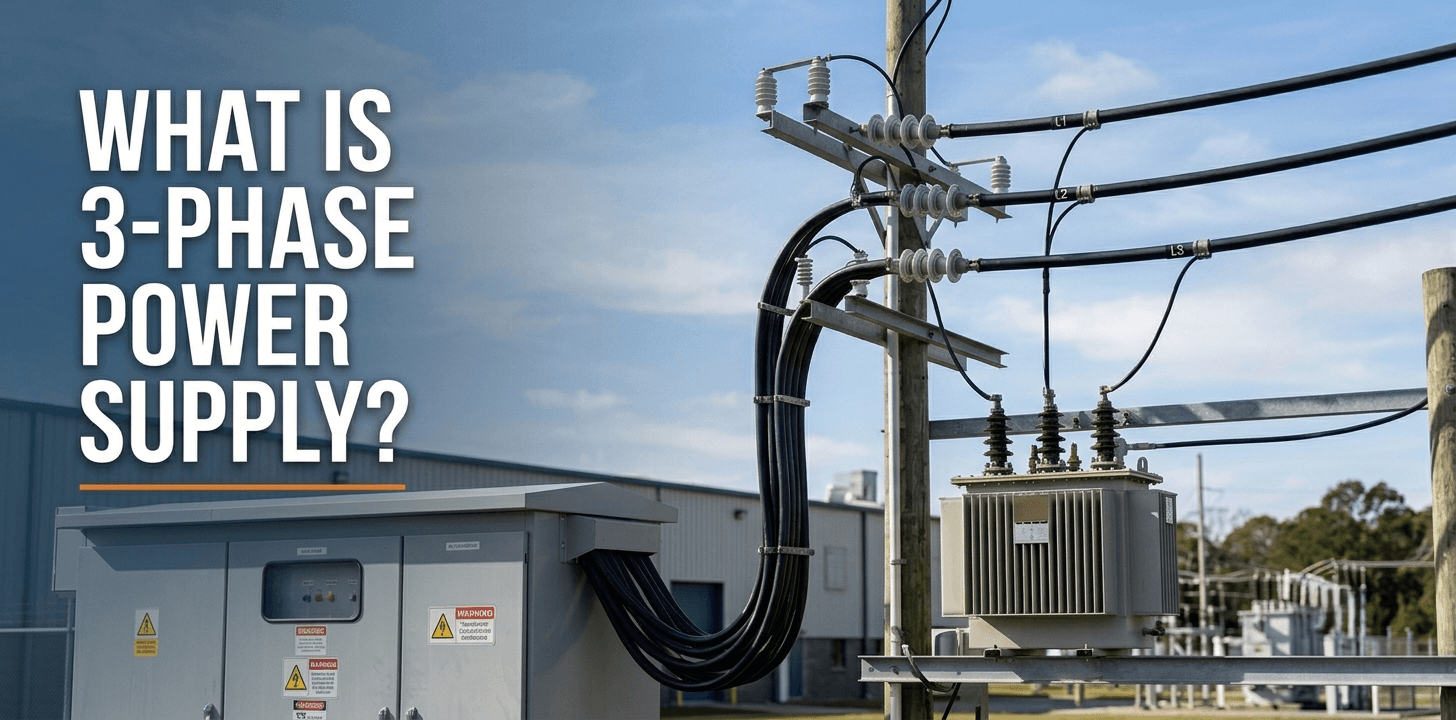
What is a 3-phase power supply?
Homes in the UK are all equipped to supply appliances with single-phase power. Single-phase power provides a constant, efficient 230 V supply. While single-phase power is the standard across UK households, it does not provide a strong enough supply for many bigger industrial machines. Powering industrial machines often requires a 3-phase power supply.
3-phase electricity is a way of delivering high-voltage alternating current through three wires. The use of three different wires provides a consistent current delivery and supports loads. While most homes do not need anything more than single-phase power, some larger machinery, like industrial air conditioners, does require your home to be retrofitted with 3-phase power.
3-phase power might be a nice-to-have option for homes, but it is an absolute necessity for industrial settings like warehouses, factories, and large buildings. These settings need higher power outputs that deliver a stable power supply. A 3-phase power system can reach a top end of over 100 kW. This means it can provide much higher power outputs than single-phase power, which usually maxes out at 23 kW to 24 kW. The higher output of 3-phase systems allows industrial facilities to run high-power cooling and HVAC systems like industrial air conditioners, evaporative air coolers, and wall-mounted air conditioners.
How 3-Phase Power Works
The Basics of 3-Phase
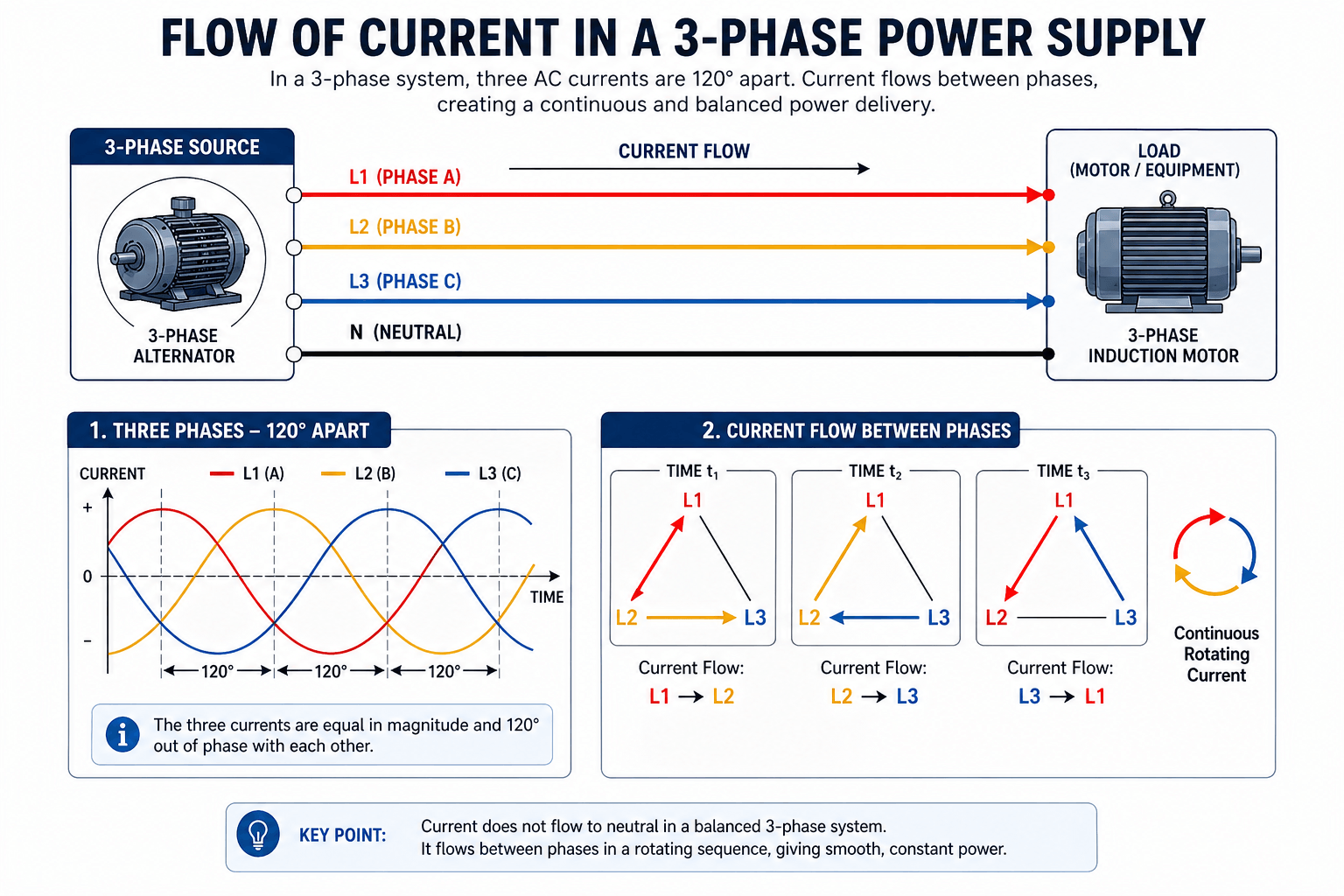
3-phase power delivers a constant flow of current made possible by the three wires separated by 120 electrical degrees. In essence, current flows through each wire at different times, meaning that the flow never truly stops.
Here is a simple analogy: Think of the three wires as three water pipes carrying water from a water source to your tap. If there were just a single pipe, there would only be a single flow of water. As the water flows into the pipe, the pipe will first have to push that stream to the tap before it can take on another stream. This means that the pipe is in a constant state of flow and pause. In this analogy, the flow and pause represent the flow of current. In single-phase systems, current will flow one way, pause, and then allow the next current to flow.
3-phase systems consist of three pipes instead of one. As one pipe empties, another pipe is already filled with a new flow. The cycle of current passing through 3 pipes means that there is never a pause in the current, as each pipe is constantly feeding a new stream of water to the tap. In 3-phase power systems, current flows through each wire at different intervals, meaning that as one wire delivers current, the next wire is standing by to deliver the next.
Overview of how 3-phase systems work:
Three equal currents are generated and distributed across the 3-phase system.
These currents are separated by 120 electrical degrees.
As one current rises, another falls.
This process is repeated in an endless loop.
The 3-phase loop provides a constant, stable supply of high voltage energy.
Why 3-Phase is More Efficient
Not only do 3-phase power supplies provide stronger power sources for industrial equipment, but it also works more efficiently than single-phase systems.
Some of the reasons why 3-phase power systems are more efficient include:
Constant Supply: No pauses in the supply of current.
Reduced Power Costs: 3-phase power systems require less conductor material, resulting in lower costs.
More Power: 3-phase systems can support greater current loads.
Components in a 3-Phase Power System
Generators
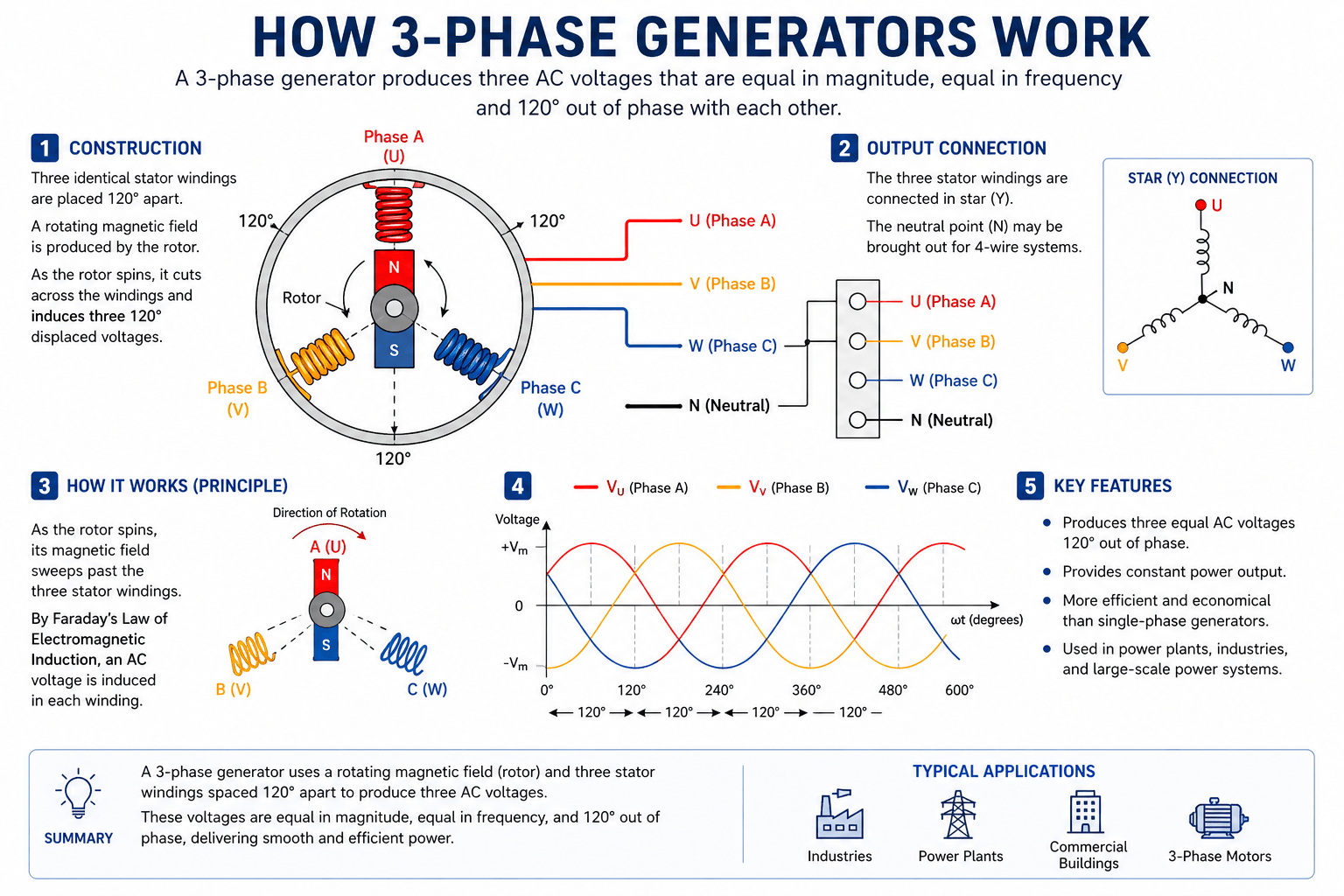
3-phase power starts with a generator. For most commercial and industrial properties, 3-phase power is supplied by the UK grid. In places where standard 3-phase power is not supplied by the grid, a 3-phase generator can be installed. These generators create the 3-phase power using a rotating magnet that is surrounded by three individual coils. These coils are arranged to generate the 120-degree phase shift.
Transformers
Transformers are added to the system to step the voltage up or down for either long-range distribution or safe local use. 3-phase transformers can fluctuate the voltage between 480V, 277V, 240V, 208V, or 120V.
Transmission Lines
High-voltage transmission lines are used to transport 3-phase power from generators or main-grid power stations to substations. From these substations, the 3-phase power is then delivered to industrial loads.
Loads
The high-voltage output of 3-phase power systems is best suited for industrial loads. These include factories, production facilities, and warehouses. 3-phase power is also uniquely suited to heavy-duty cooling systems like industrial air conditioners, commercial HVAC installations, and data centre cooling.
3-Phase Connection Types
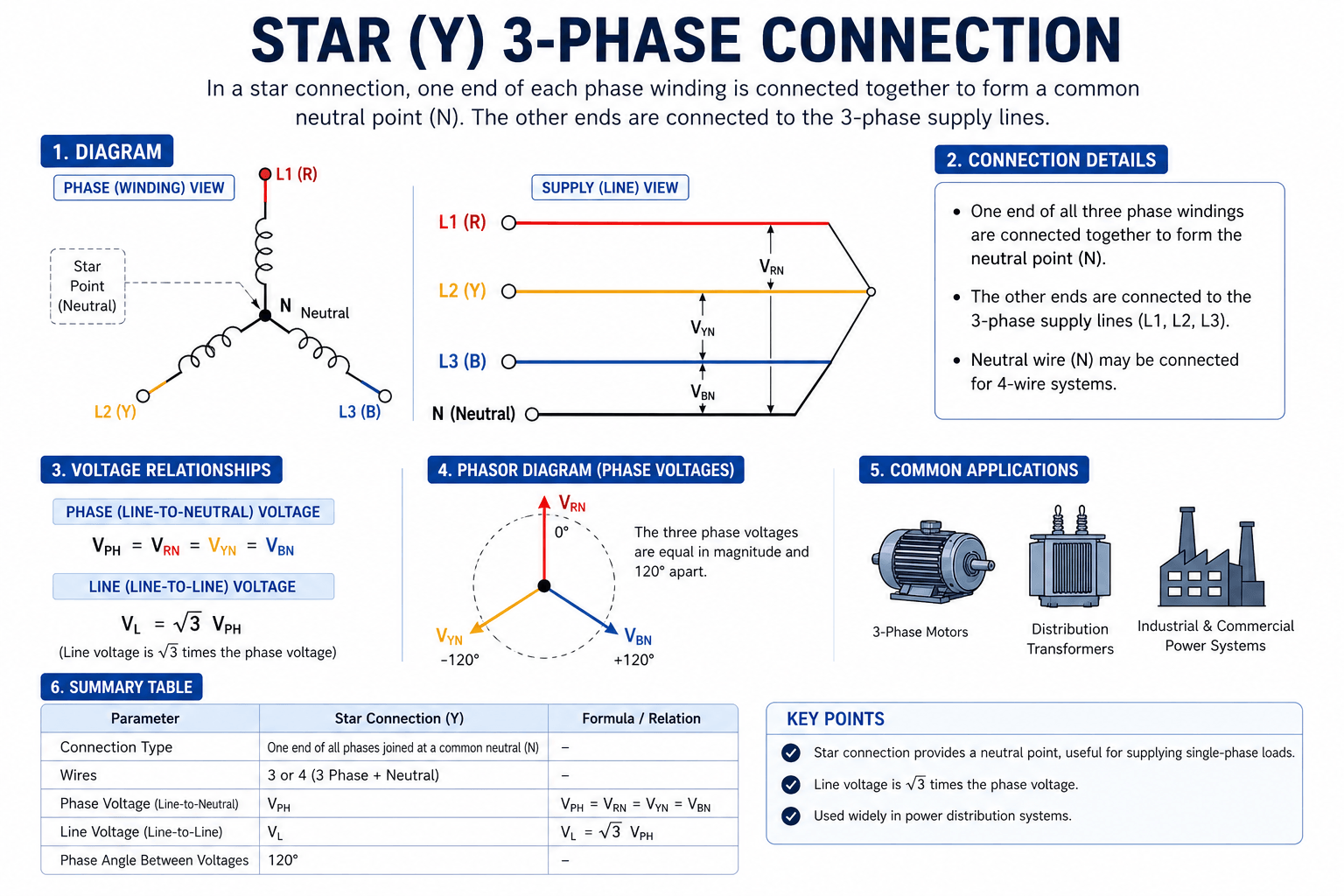
Star (Wye) Connection
This connection type features 4 wires. 3-phase wires and 1 neutral. All the phase wires are connected to the neutral wire at the ends, forming a star-shaped connection.
Star connections are best for:
Long-distance transmission.
Power distribution.
Dual-voltage supply.
Delta Connection
Delta connections use 3 wires instead of 4. This connection type is called a delta connection because the 3-phase wires are connected end-to-end to form a triangle.
Delta connections are best for:
High-voltage transmission.
Factory equipment requiring large power supplies.
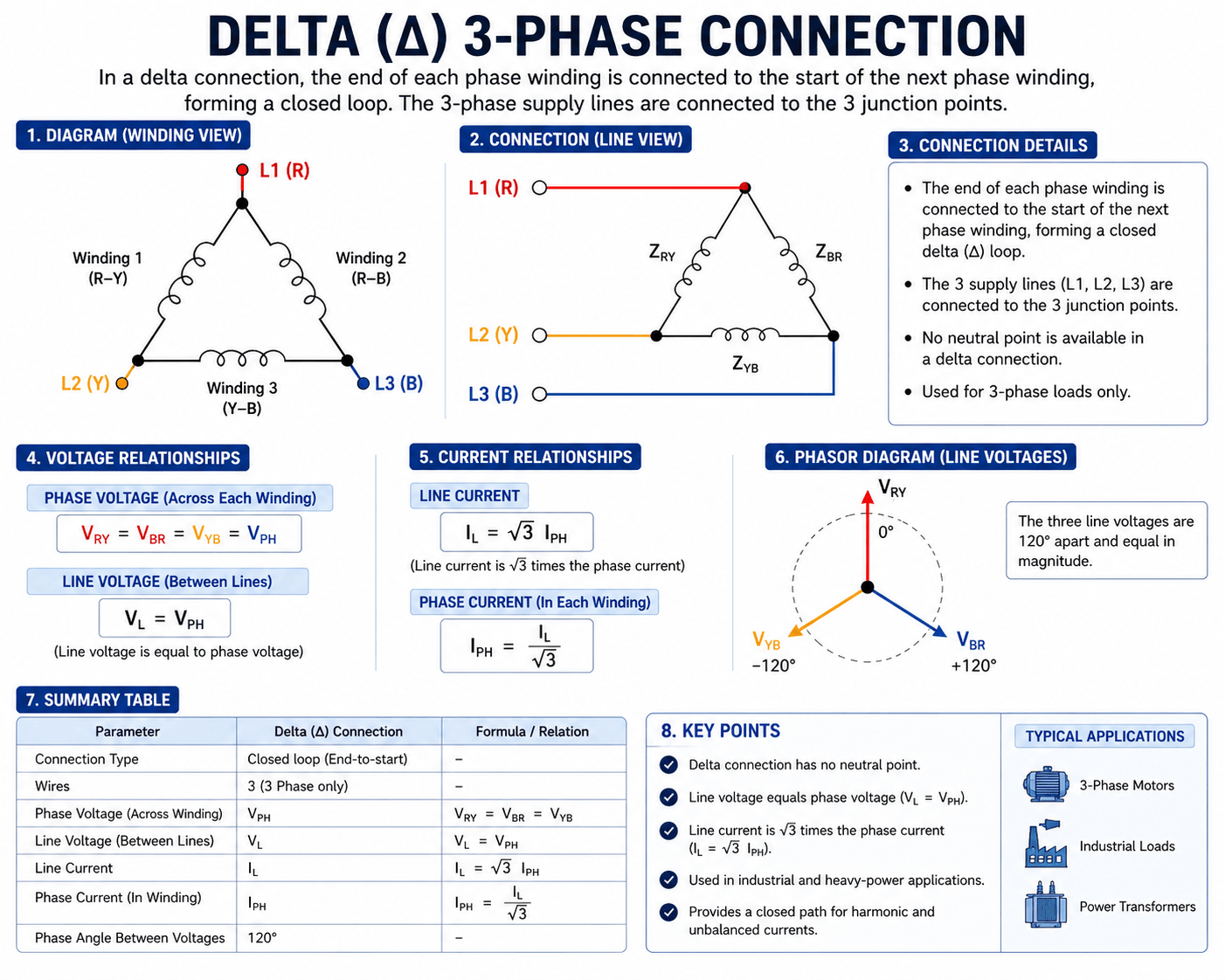
Differences Between Star Connection and Delta Connection
Star Connection | Delta Connection | |
|---|---|---|
Number of Wires in the System | Three phase wires One neutral wire | Three phase wires |
Number of Systems made possible | 4 – Wire 3 – phase system 3 – Wire 3 – phase system | 3 – Wire 3 – phase system |
Connection Points | Phase wires connect to the neutral wire, forming a star. | All phase wires connect end-to-end, forming a triangle. |
Insulation Requirements | Requires less insulation. | Requires more insulation. |
Transmission Distance | Long-distance transmission. | Short-distance transmission. |
Phases Possible | Both single and 3 phase possible. | Only 3 phase possible. |
3-Phase Power Supply VS Single-Phase Power Supply
Feature | Single-Phase Power | 3-Phase Power |
|---|---|---|
Voltage | 110V–240V (Reduced voltage suitable for residential use) | 380V–415V (higher voltage across phases suitable for industrial areas) |
Efficiency | Less efficient for heavy loads; power delivery fluctuates | Highly efficient; delivers constant, balanced power with no dips |
Cost | Lower installation cost; simpler wiring system | Higher initial setup cost but more cost-effective for large-scale or continuous operations |
Applications | Homes, small offices, lighting, and low-power appliances | Industrial machinery, large motors, HVAC systems, factories, and commercial buildings |
How HVAC Cooling Systems Use 3-Phase Power
Industrial Uses for 3-Phase Power Supply
Industrial facilities like factories, warehouses, and production plants have much higher cooling requirements than residential spaces. These facilities experience high levels of heat from production processes and constant foot traffic. As a result, high-powered cooling systems are required to effectively cool large spaces.
In addition to large cooling systems, these systems must also meet energy efficiency requirements and standards. Cooling systems powered by a 3-phase supply can achieve both these goals. Because a 3-phase supply can support greater loads, industrial cooling systems can be much larger. The steady supply of current also means that industrial cooling systems can run for long periods of time, uninterrupted.
Some of the cooling systems that 3-phase power can supply:
Industrial coolers and HVAC systems
High-demand heat pump air conditioners
Data centre cooling systems
Commercial Settings Where 3-Phase Power Can Be Used
Production Facilities
Factories
Warehouses
Shopping Centres
Data Centres
Can 3-Phase Power Be Used in Your Home?
Yes, you can use 3-phase power in your home. While it is possible, it is not common practice for 3-phase power to be installed in residential settings. Most household appliances do not need 3-phase power. This is why a 3-phase power supply is not installed in homes by default.
Why You Might Need 3-Phase Power at Home
You might need to install 3-phase power in your home for one of the following reasons:
Have a home workshop with industrial-grade machinery or equipment.
Have an electrical vehicle charger installed.
Need a much higher total power capacity that exceeds 23kVA.
Installing a 3-Phase Power Supply in Your Home
Setting your home up with a 3-phase power supply is not a simple task, and it should be done by a qualified electrical specialist.
The process of installing 3-phase power in your home is as follows:
Determine your power needs. Before installing a 3-phase system, calculate the total power load of your home. If the load exceeds what a single-phase system can handle, then you need a 3-phase system. (Pro Tip: Consult an electrician for a comprehensive load calculation)
Send an application to the local Distribution Network Operator (DNO) for a physical connection upgrade. The DNO will provide you with an overview of the costs involved with upgrading to a 3-phase connection.
Get the DNO to upgrade the service cable and electricity meter. Your old service cable and meters will be replaced with new 3-phase ones.
Once the DNO has upgraded your service cable and electricity meter, you will then need to contact an electrician for them to install a 3-phase distribution board.
After the distribution board is installed, the load must then be balanced to ensure even power distribution across all your devices.
When all the above steps are completed, the installation must be certified with your local electrical council to ensure it meets the correct standards.
Is 3-Phase Power the Ultimate Power Solution?
3-phase power offers many benefits when compared to single-phase power. From being more efficient to supporting greater loads, 3-phase power is an overall better system. 3-phase power is not suitable for all applications and loads. It is best used when electrical loads exceed 23kVA.
It is unlikely that your standard household needs a 3-phase system, as these power supply systems are mostly used in industrial and commercial environments. Commercial power needs and industrial processes are more power hungry than standard household appliances.
While it is not common for homes to use 3-phase power, it is still possible. If you are running heavy-duty machinery in your home or have a small workshop, 3-phase power will meet your power needs more effectively.
If you need to power industrial-grade cooling systems, like our range of commercial coolers and heat pumps, then you will need to install a 3-phase system to accommodate the extra load. If you are still trying to decide if 3-phase power is for you, use our simple running cost calculator to determine if it will suit your budget. Also, check out our industrial air conditioner options. Our commercial and air conditioners all run on 3-phase power and have enough output to cool large areas.
Frequently Asked Questions About 3-Phase Power
What is the difference between 3-phase power and single-phase power?
3-phase power supports a greater power load, being able to handle upwards of 23kVA.
What makes 3-phase power more efficient?
Using three-phase wires means a constant supply of current can be maintained, reducing power drops and increasing load balancing efficiency.
Can I install 3-Phase power in my home?
While it is not common to find 3-phase power in residential homes, it is possible to install and use 3-phase power at your house.
What kind of equipment uses 3-Phase Power?
Industrial and commercial machinery, as well as appliances that require a high-power source.
Why is 3-phase power used in industrial settings?
Industrial environments, like factories or data centres, have high electrical loads. 3-Phase power can easily power these loads thanks to its high-powered alternating current.