


What are Evaporative Air Coolers and How Do They Work?
Date: Invalid Date
What Are Evaporative Air Coolers?
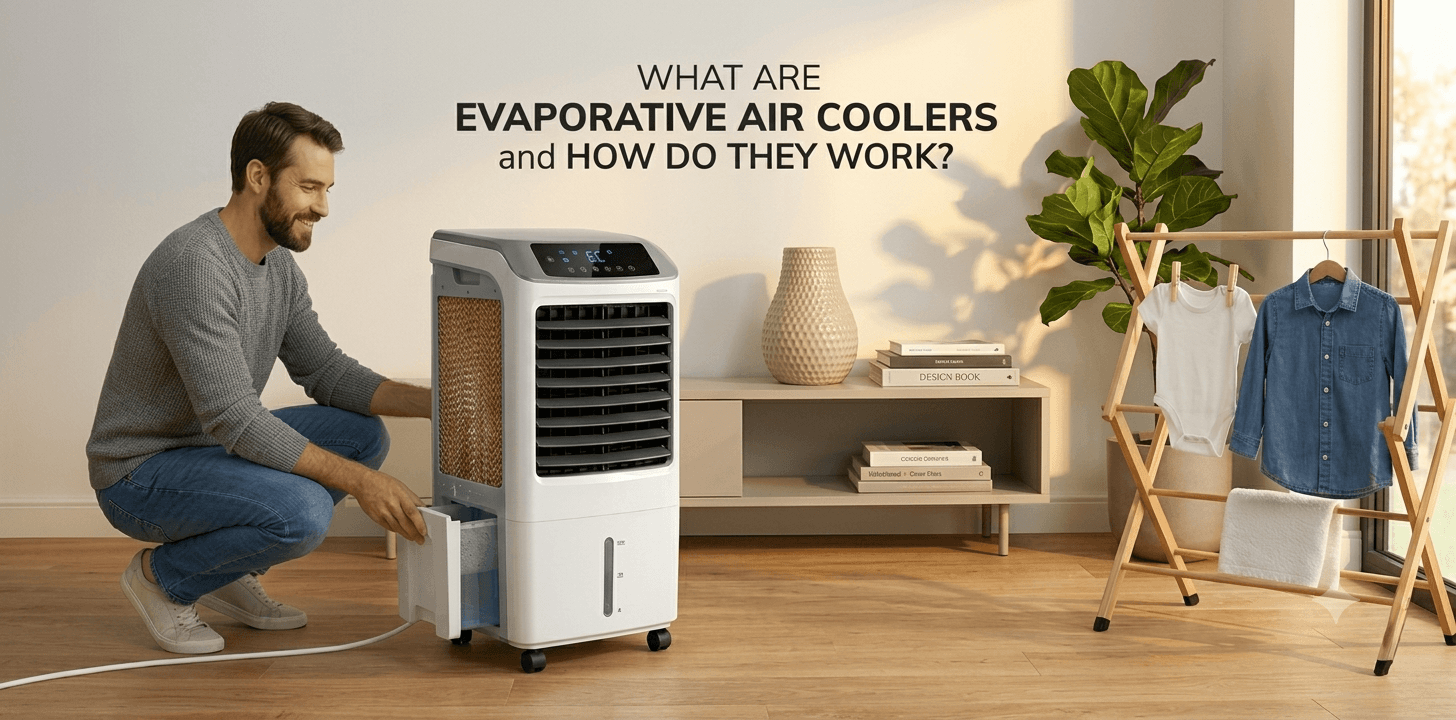
Evaporative air coolers (also known as swamp coolers) are electrical climate-control devices that use the natural cooling effect of evaporation to cool air. Think of it as an air conditioner that uses natural cooling methods (like water) instead of refrigerants to create cool air. Evaporative cooling systems allow you to control both the temperature and humidity in a variety of spaces, which is particularly useful in hot and dry areas.
Despite the simple design of evaporative cooling systems, they can cool a wide range of indoor and outdoor areas from 10m2 to 500m2. Portable evaporative coolers do not use exhaust hoses like traditional air conditioners, resulting in devices that are easy to install and cheap to maintain.
How Do Evaporative Air Coolers Work?
In simple terms, evaporative coolers draw in warm air from the surrounding area with an intake fan and pass that air through cooling pads drenched in water. As the warmer air interacts with the water, it naturally causes water to evaporate, adding humidity to the air. The cooler, humid air is then vented back out into the space in which the evaporative air cooler is placed.
A simple analogy we like to use to explain the evaporative cooling effect is the cold feeling you get when you get out of a pool. When the warmer air outside the pool interacts with your wet skin, the water on your skin evaporates. It is this evaporation that causes you to feel cooler almost instantly.
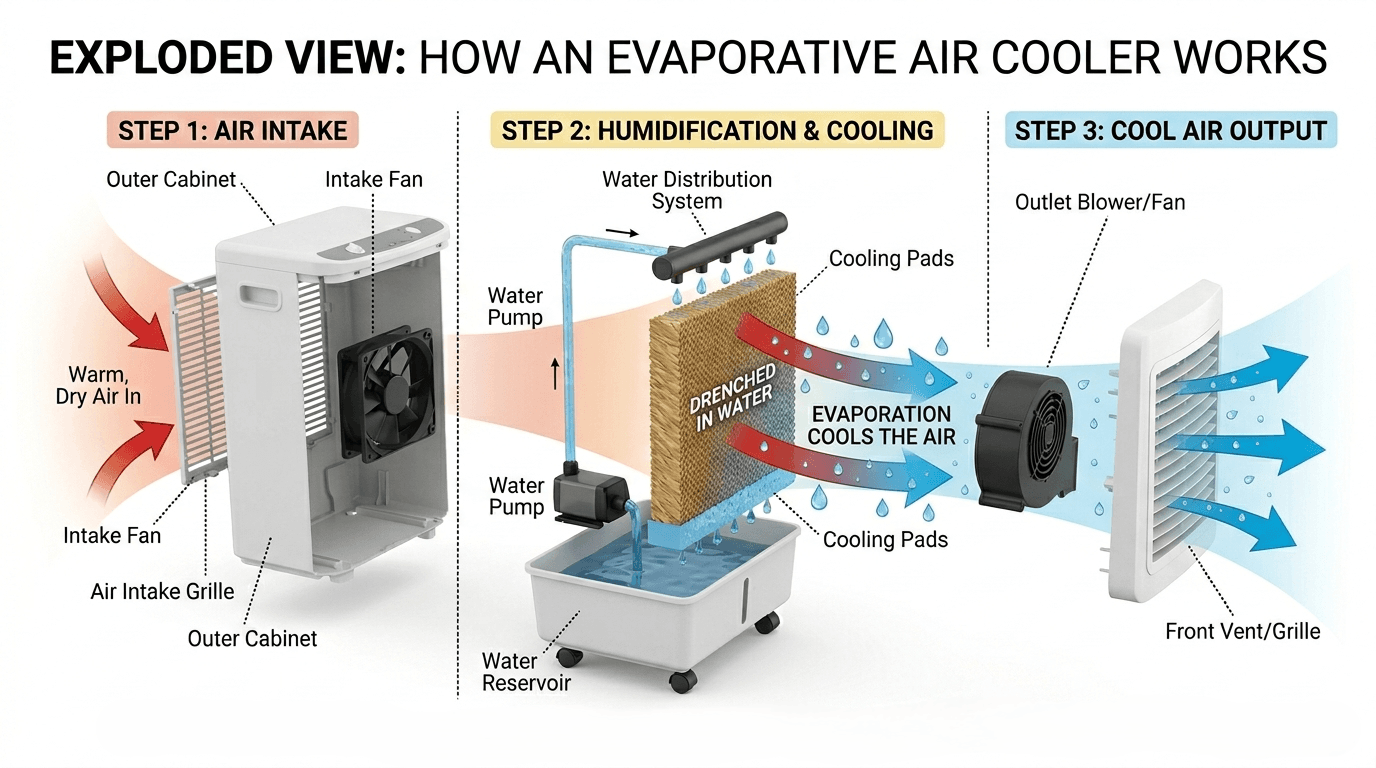
Please note that because these devices cool the air by introducing humidity, they must be used in spaces that are well ventilated. Using an evaporative air cooler in a space with a high relative humidity level can result in less effective cooling.
Types of Evaporative Air Coolers
There are 3 main types of evaporative air coolers, explained below, and at National Heater Shops, we stock a comprehensive range of evaporative air coolers.
Direct Cooling Evaporative Cooling Systems
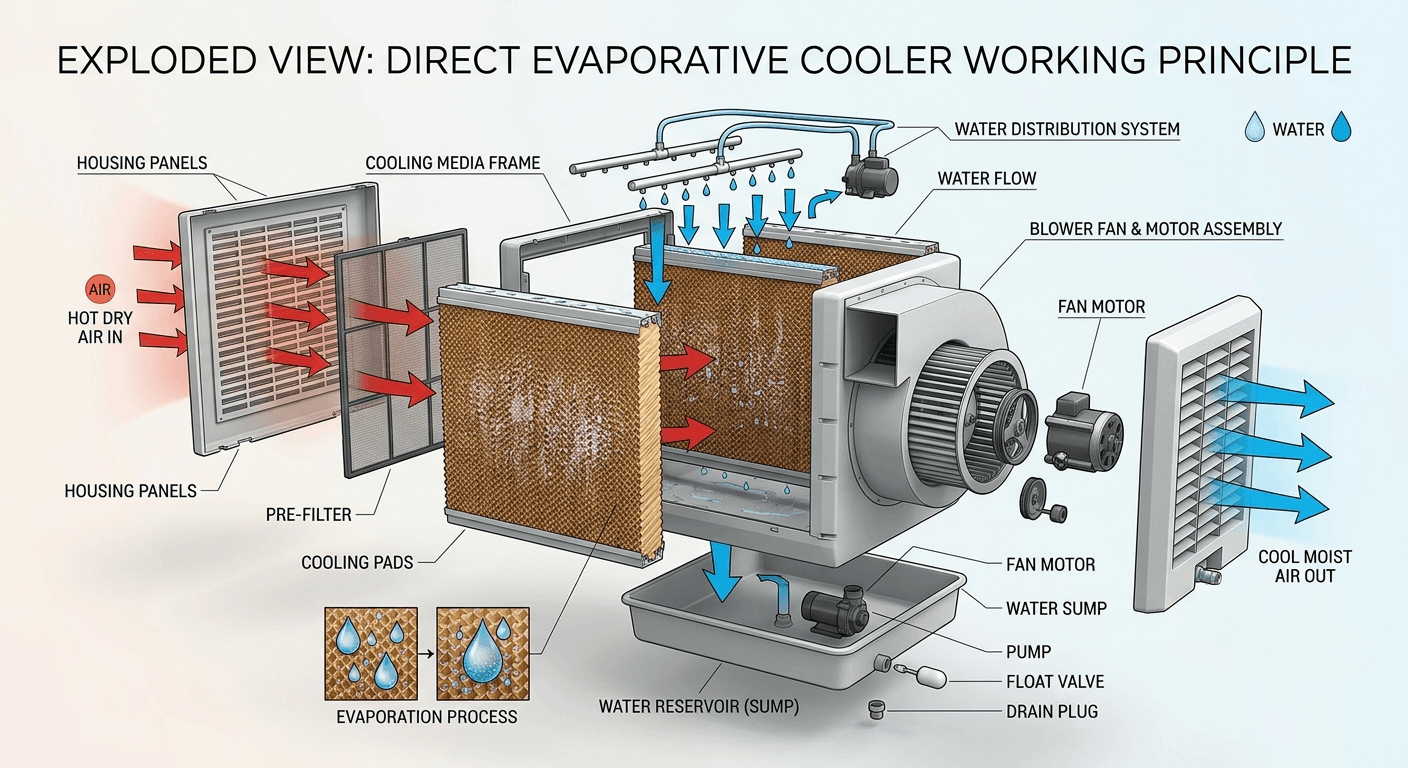
In direct cooling units, the air comes into direct contact with the water or cooling pads. The air is then cooled and vented back into the surrounding area.
Best used in spaces with:
High temperatures
Low humidity
Good Ventilation
Indirect Cooling Evaporative Cooling Systems
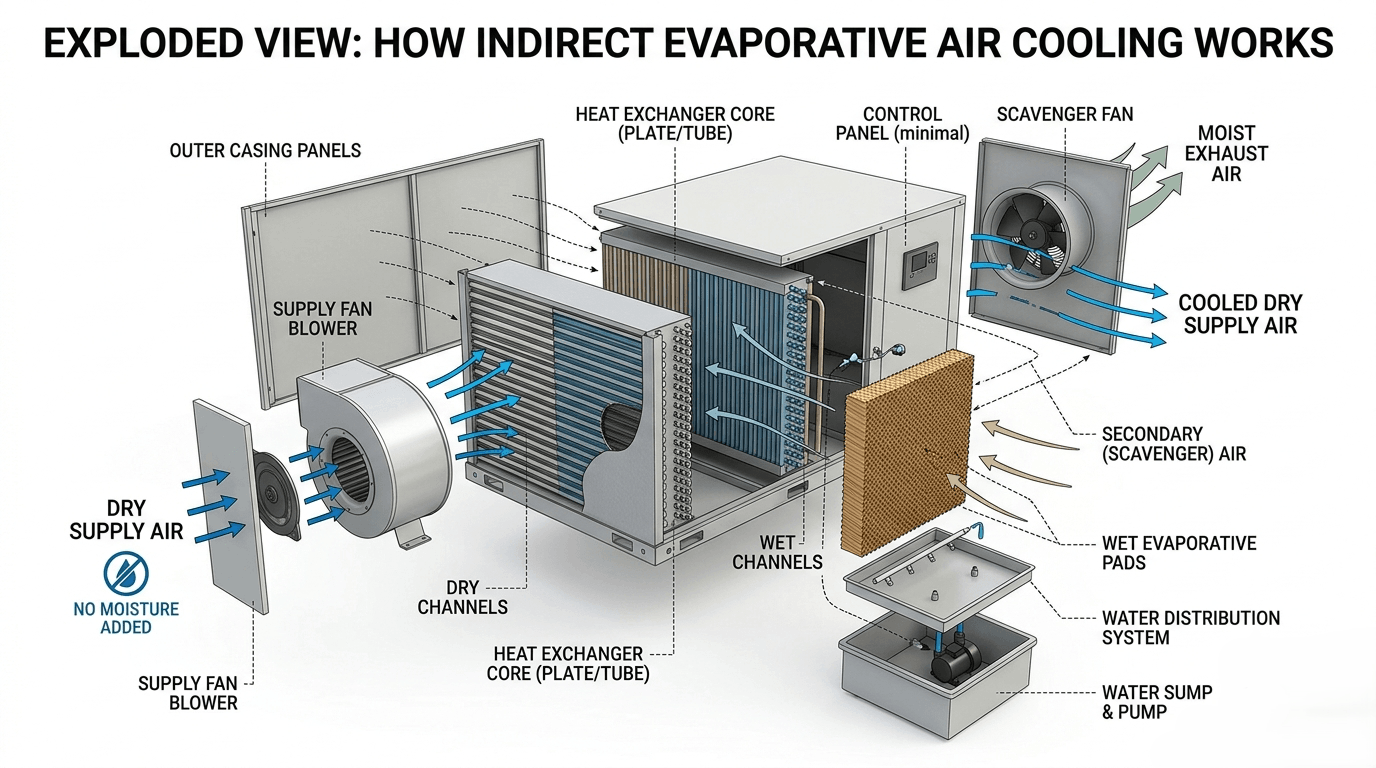
With indirect cooling units, the air and water do not make direct contact. Instead, a dry heat exchanger is used to cool the air that has been drawn in. Water is still used in this kind of system, but instead of directly cooling the air, the water is used to cool the dry heat exchanger.
Best used in spaces with:
High temperatures
High humidity
Poor Ventilation
Mixed Evaporative Cooling Systems
By combining the features of both direct and indirect systems, mixed cooling systems offer users the opportunity to select between using their air cooler as a condenser or evaporative system.
Having the option to switch between direct and indirect cooling allows mixed systems to be used in a variety of rooms. From hot and dry rooms to hot and humid environments, these devices can be considered an all-in-one evaporative cooling solution.
The Benefits of Evaporative Air Coolers
Fresher Air
Evaporative air coolers deliver a steady stream of fresh air by constantly drawing in air from the surrounding area and venting cooler air back into the same space, meaning stale air is never recycled. The introduction of humidity into the cool air also means that these devices can be used with open doors and windows, reinforcing a constant supply of fresh air.
Having a constant stream of fresh air has many benefits, including:
Removal of foul air.
Reduction of air-borne germs.
Reduced chance of mould.
Reduced Energy Bills
Thanks to energy-efficient designs, evaporative air coolers can significantly reduce your energy bill. Evaporative air coolers only use a small amount of energy to power their fans and heat pumps. This means that on average, these devices can use 80% to 90% less power than traditional air conditioning systems.
Evaporative Air Cooler vs Air Conditioner Energy Consumption Comparison | ||
|---|---|---|
Evaporative Air Cooling | Air Conditioner | |
Standard Power Usage | 50 - 300 Watts | 900 - 3500+ Watts |
Power Usage per Hour | 0.05 - 0.30 kWh | 0.9 - 3.5+ kWh |
Monthly Energy Consumption (8 hrs/day) | 12 - 2 kWh | 216 - 840+ kWh |
Energy Efficiency | Very high | Moderate to high |
Simple Installation and Less Maintenance
Evaporative air coolers are simple electrical devices that use just a few parts to achieve their cooling effect. With nothing more than a few fans, a heat pump, and cooling pads, these devices are easy to maintain. The result of this is lower maintenance costs and less downtime when repairs are needed. In most cases, the repair of an evaporative air cooler is as simple as switching out a faulty part.
Remember, despite these devices being easy to repair and maintain, it is highly recommended that all repairs and maintenance be performed by trained technicians.
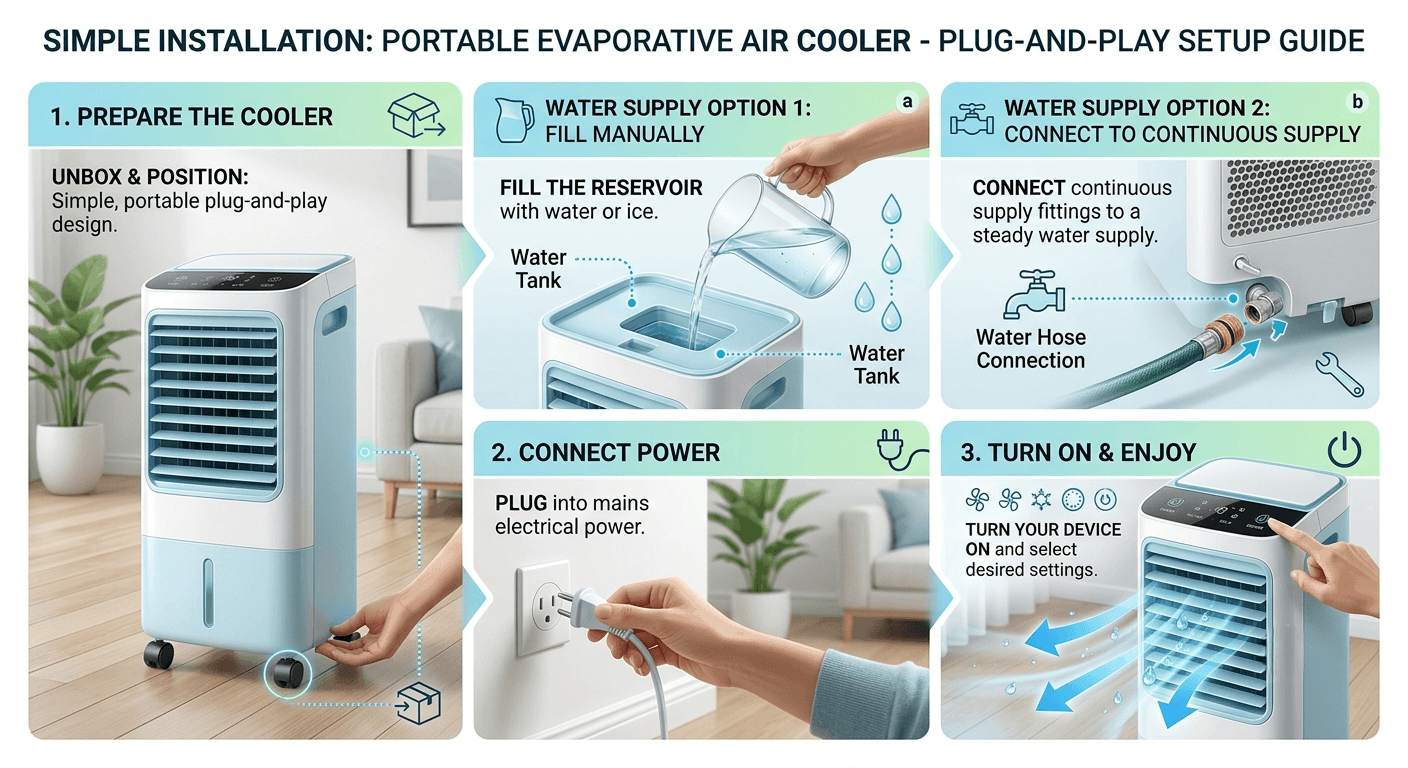
Installation is just as simple. In most cases, evaporative air coolers are portable plug-and-play devices. All you need to do is fill the reservoir with water or connect the continuous supply fittings to a steady water supply, plug your device into the mains, and turn it on.
Sustainable Cooling
Using water to cool hot air instead of refrigerant gas used by traditional air conditioners means that evaporative air coolers are kinder to the environment. Dangerous greenhouse gases are not created during the cooling process, resulting in a cleaner and greener device.
Combined with low energy use, evaporative air coolers are the perfect cooling solution for anyone who is conscious of their carbon footprint.
More Efficient Cooling on Hot Days
The higher the ambient temperature outside the evaporative air cooler, the more it will cool the space. This cooling effect is based on both the ambient temperature and the level of relative humidity present. At higher temperatures and lower relative humidity, the cooler will work more optimally.
Where Can You Use Evaporative Cooling Systems?
Inside Spaces
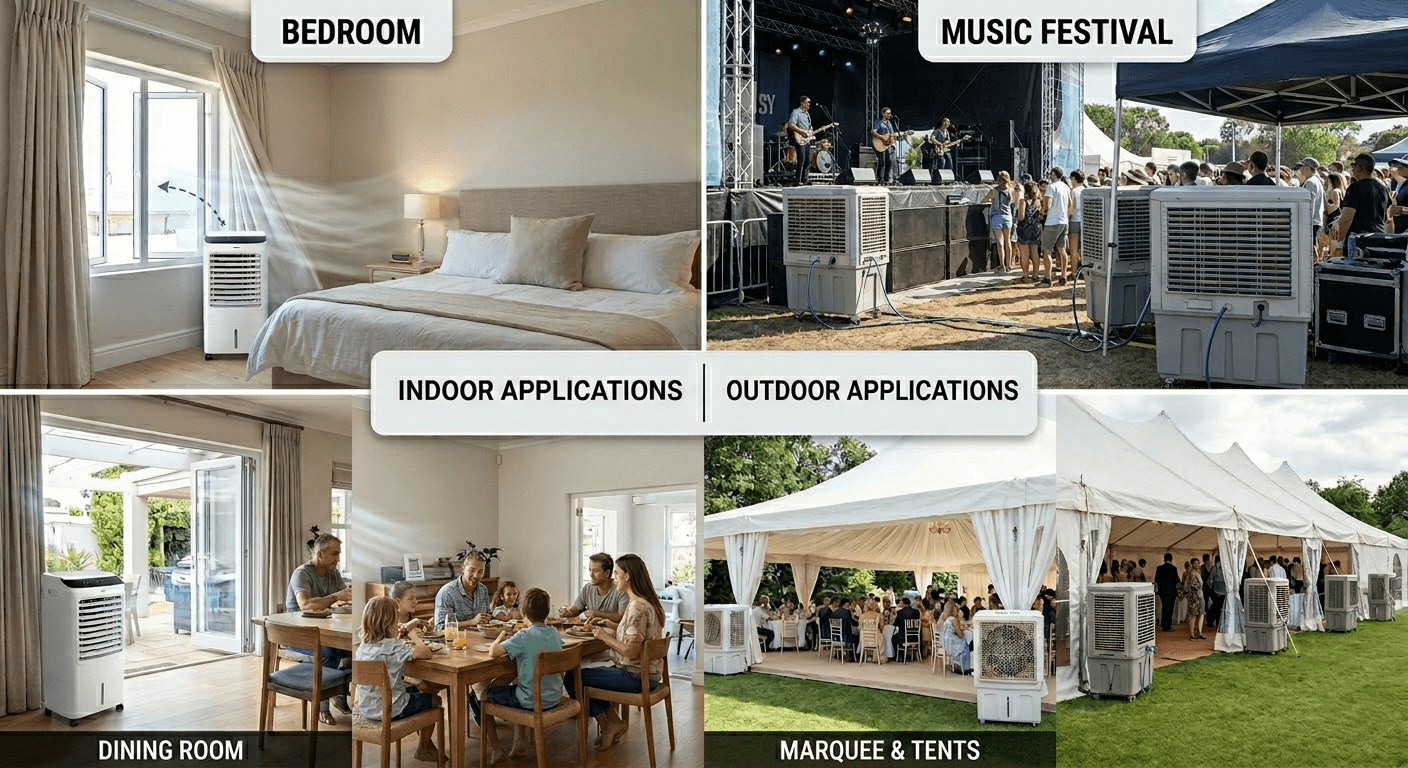
Indoor rooms like bedrooms and dining rooms with sufficient ventilation are just two examples of where evaporative air coolers can be used inside. An important note: ventilation is very important when using an evaporative air cooler indoors. Without sufficient ventilation, condensation can build up, leading to corrosion or mould.
When used indoors, it is recommended that the cooler be placed close to a window or door. This will allow the cooler to draw in a maximum amount of air, increasing the cooling capacity.
Outside Spaces
Evaporative air coolers are great for outdoor use as it requires a constant stream of fresh and excellent ventilation to operate optimally. Provided sufficient access to water and a stable power supply, these coolers are the perfect outdoor cooling solution. Outdoor settings where portable evaporative air coolers can be used include:
Music shows.
Weddings.
Outside tents and marquees.
Easy installation and mobility also mean that these coolers can be used across a wide variety of outside spaces. You can also move the cooler around to cool different areas as needed. Factors such as portability and ease of use make evaporative air coolers popular choices for restaurants, bars, hotels, and residential users.
Where Should You Not Use Evaporative Cooling Systems?
Since evaporative air coolers cool air using water, there are certain situations in which usage is advised against. These include:
Spaces that contain equipment sensitive to humid conditions, such as servers or electrical devices.
Scenarios where humidity levels must be strictly maintained.
Poorly ventilated areas.
Tips For Using Your Evaporative Cooler
Always place your cooler in a well-ventilated area.
Evaporative cooling systems work best when placed close to an open door or window.
Your cooler will cool more optimally at temperatures above 25°C and humidity less than 60%
Check the size of the space you want to cool and ensure the cooler provides adequate cooling for that space.
For alternative cooling options, check out our ranges of portable air conditioners, wall-mounted air conditioner units, and cooling fans.
Still unsure which unit is best for you? Contact us or speak to our friendly sales team for advice regarding any of our cooling equipment.
Choosing Your Evaporative Air Cooler
Before purchasing your evaporative air cooler from National Heater Shops, look at our convenient buying guide below. This guide is expertly designed to help you determine which evaporative air cooler is the best option for you by analysing a variety of factors.
Evaporative Air Cooler Buying Guide | ||
|---|---|---|
Buying Tip | Recommended Standard | |
Cooling Area Size | Measure the square meterage of the space that needs cooling (m2). | Ensure the airflow (m³/h) matches the space’s size |
Airflow Capacity | Check airflow rating. | Small: 1,500–3,000 | Medium: 3,000–6,000 | Large: 6,000+ |
Climate Suitability | Assess humidity levels. | Best for dry climates (<60% RH) |
Water Tank Capacity | Check tank size. | 20L+ recommended for longer runtime |
Power Consumption | Check wattage. | 50–300W typical |
Fan Speeds | Look for a unit with multiple fan speed settings. | Find a cooler with at least 3 speeds |
Features | Look for features that improve usability. | Features like remote, timer, and swing function improve usability |
Efficiency | Compare airflow vs power. | Higher airflow per watt is better |
Budget | Compare pricing. | Balance cost vs features |
Are Evaporative Air Coolers Worth Buying?
Evaporative cooling systems are worth purchasing for hot and dry climates. In such environments, evaporative air coolers are known to outperform traditional air conditioners. Additionally, evaporative air coolers would also be a better option if you are looking for portable cooling solutions that can be used both indoors and outdoors.
While we stock a variety of cooling products from various brands, our evaporative air cooling systems are highly recommended for anyone looking for a cost-effective cooling solution. These solutions not only offer greater long-term energy savings, but it also reduces operating costs thanks to simple maintenance.
If you are looking for a portable cooling solution for either an indoor or outdoor space, check out our evaporative air cooler section. There you will find a range of coolers that include portable direct coolers as well as evaporative air coolers that include infrared technology.
Frequently Asked Questions About Evaporative Air Coolers
Can I run an evaporative air cooler overnight?
Yes, if the evaporative air cooler has access to a steady water and power supply, the device can run all night. Remember to ensure that the area it is running in is well ventilated.
Are evaporative air coolers better than air conditioners?
Evaporative air coolers have many benefits over traditional air conditioners, including reduced operating costs, easy maintenance, and portability.
Is it necessary to leave the windows open when an evaporative air cooler is running?
Yes, the device must run in a room that is well ventilated to ensure that humidity levels remain within a comfortable range. If the device runs in a poorly ventilated space, it could result in increased condensation. This increases the risk of mould and corrosion.
What is the lifespan of an evaporative air cooler?
Evaporative air coolers have a general lifespan of 10-15 years, but can last up to 25 years if properly maintained.
Are evaporative air coolers cheaper to run than conventional air conditioning?
The simple design of evaporative air coolers means that it uses less energy to cool bigger areas than traditional air conditioning. This reduced energy cost makes evaporative air coolers cheaper to run over longer periods of time.