


Why Evaporative Air Cooling is the Cost-Effective Solution for Industrial Spaces
Date: 15 June 2025
One of the largest problems in industrial environments such as factories, warehouses, and production plants is a buildup of heat. Factors in these environments that contribute to these high temperatures include roofs made from metals such as aluminium. Manufacturing processes and a large number of people in small spaces also play a major role in rising temperatures. Combatting this heat is an ongoing issue for the owners of these facilities, which is why our team at National Heater Shop provides a wide range of cooling solutions, from traditional air conditioning and fans to the latest evaporative air-cooling systems.
Rising temperatures and the recent heatwave have made it clear that more efficient cooling systems are needed. Alongside the need for more efficient cooling systems, rising energy costs and tightening regulations mean that traditional industrial climate control solutions are no longer good enough. Instead, new technologies, like evaporative cooling systems, are becoming the future of commercial cooling.
As experts in the HVAC field, we have supplied many evaporative air-cooling systems to the industrial sector, and we can see the benefits of evaporative cooling. Some of the primary benefits of these systems include more efficient cooling of large spaces, as well as greater energy efficiency.
What Are Evaporative Air Coolers?
How Do Evaporative Cooling Systems Work?
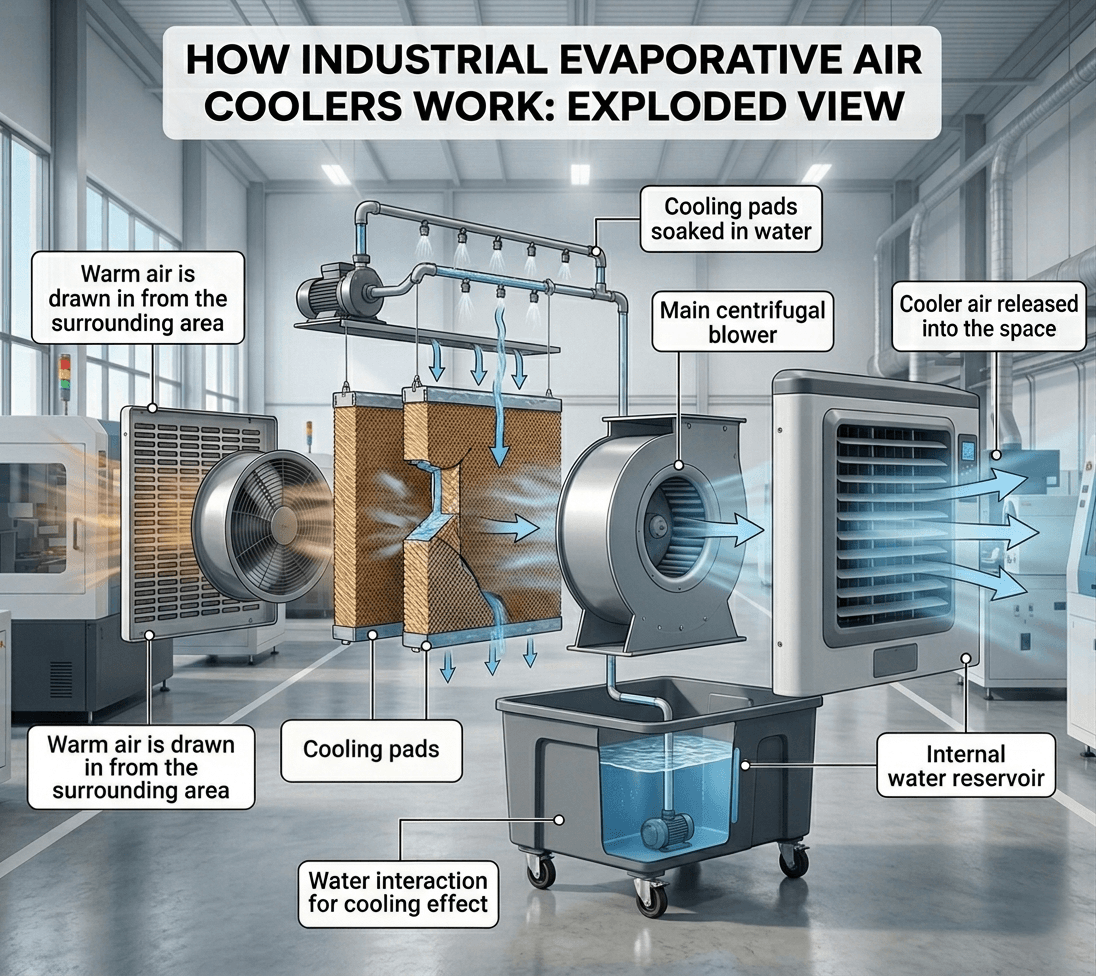
Evaporative air coolers are simple electrical cooling devices that use the natural cooling effect of evaporation to cool spaces. They do this by introducing warm air to water. Once warm air interacts with water, the water evaporates, adding humidity to the air and cooling it. This cooler air is then blown back into the space being cooled.
In simpler terms, the process looks as follows:
Warm air is drawn in from the surrounding area.
The warm air is then passed through cooling pads that are soaked in water.
Once the air interacts with the water, the cooling effect takes place.
Cooler air is then released back into the space being cooled.
Here is a simple graphic showing this process in an industrial environment.
Components of an Evaporative Air-Cooling System
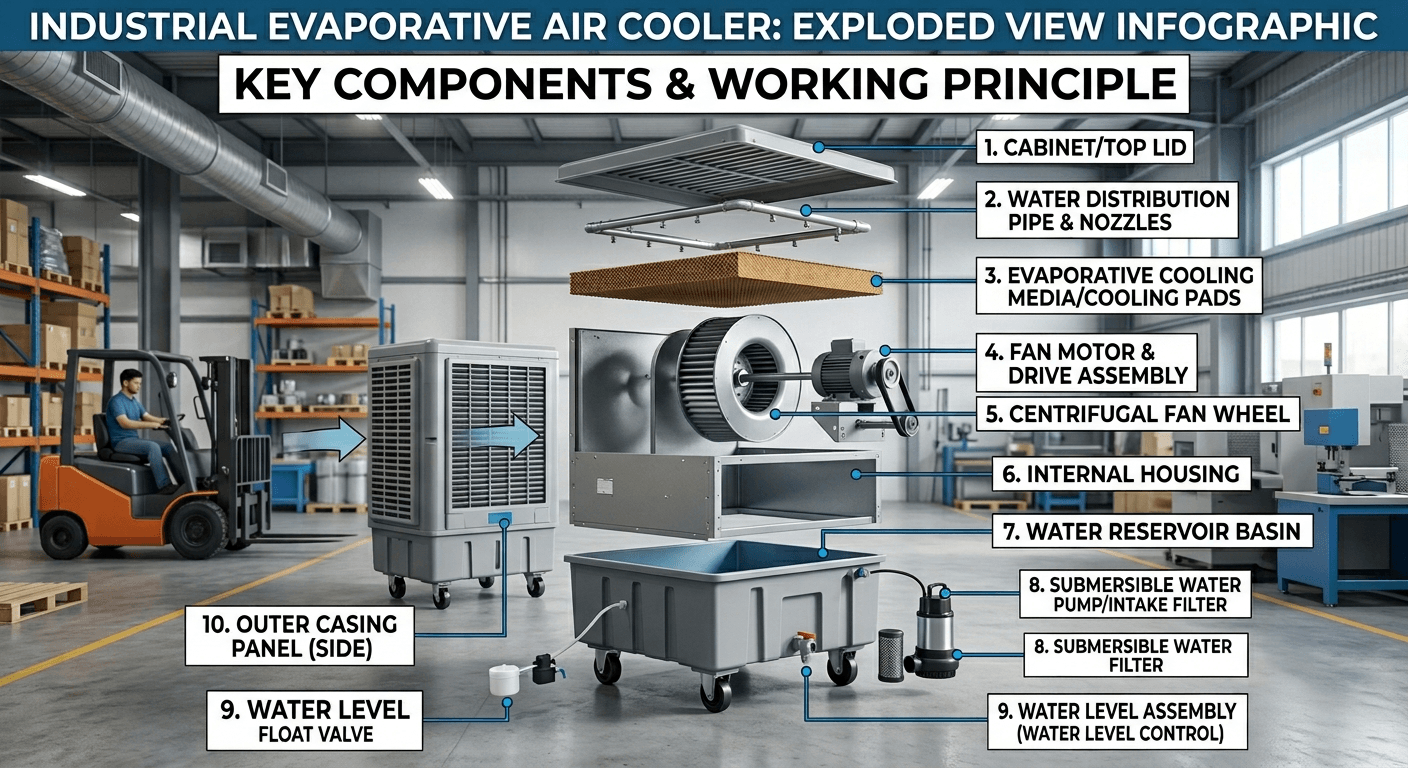
Evaporative coolers are very simple electrical devices. Most systems use a combination of fans and pumps to generate cool air. As shown in the graphic above, these coolers have no exhaust hose, meaning they are more portable than traditional commercial cooling systems and can be used in a variety of spaces.
The key components of evaporative cooling systems are as follows:
Intake Fans: These draw in the hot air.
Heat Pumps: Pumps are then used to pump the warm air toward the cooling pads.
Cooling Pads: Cooling pads soaked in water are used as the main cooling component.
Water reservoir: Used to store the water that soaks the cooling pads.
Exit Vents: This is where the cooler air is vented back out. Often also aided by a series of fans.
Benefits of Evaporative Air Coolers for Industrial Environments
The simplicity of evaporative air system designs, in addition to the portability of evaporative air coolers, provides industrial environments with many benefits. These cooling systems allow owners of industrial spaces to save money long-term by reducing energy consumption and cutting down on maintenance costs.
Energy Efficiency
Using water as a cooling medium makes evaporative cooling systems very cheap to run. The combination of a water reservoir, fans and pumps results in:
Lower Electricity Consumption: Evaporative air coolers have been shown to use 60% to 90% less power compared to traditional air conditioning.
Reduced Running and Maintenance Costs: Fewer parts mean less servicing time, and the simplicity of the systems results in maintenance procedures that are quick and affordable to perform.
This combination of low power consumption and cheap running costs makes it the perfect cost-effective cooling system for cooling large spaces such as warehouses and factories.
Reduced Running Costs
Thanks to evaporative cooling systems being portable, installation is quick, and in most cases have lower upfront costs when compared to traditional HVAC systems. Installation does not need major renovations to your existing space. This means that evaporative air coolers can be installed just about anywhere, even in small factories or warehouses with limited space.
Evaporative cooling systems also require less maintenance when compared to traditional warehouse cooling systems, such as air conditioning. Unlike cooling systems that use refrigerant technology, evaporative coolers do not need costly gas refills or maintenance. Despite this, it is still important that evaporative cooling systems be maintained regularly by professional HVAC technicians.
Perfect for Large Open Spaces
Evaporative air-cooling systems are perfect for warehouses and factories that have large ceilings, constant foot traffic, and a steady supply of fresh air due to doors and windows that are open. This is because:
Evaporative cooling works best in open environments.
It is required that doors and windows be always kept open.
Evaporative coolers can cool much larger spaces than traditional HVAC solutions.
Evaporative Coolers are Kinder to the Environment
Evaporative coolers do not use refrigerant gases, meaning no harmful greenhouse gas emissions are created during cooling. in a more sustainable industrial cooling system.
Water is a reusable resource, meaning that evaporative cooling systems have a lower carbon footprint, ideal for environmentally conscious facilities.
Improved Air Quality and Ventilation
Evaporative coolers require a constant stream of fresh air. This means that stale air is never recycled in the space being cooled.
The introduction of fresh cooled air means a reduction in harmful pollutants.
Evaporative air coolers with infrared technology, like the Rex Nordic REX25000, include infrared technology that can help kill airborne bacteria.
Evaporative Coolers vs Traditional Air Conditioning
Cooling Methods
One of the first key differences between evaporative cooling and traditional air conditioning is the cooling method used. Traditional commercial air conditioners use refrigerant gas to cool air. Evaporative coolers use water instead. This makes evaporative coolers more efficient and cost-effective to run.
Energy Use
Not having to use refrigerant gas and compressors to cool air results in evaporative air coolers using far less power than traditional air conditioners. In most cases, evaporative coolers use a small amount of power for their fans and pumps, but nothing else.
Installation Requirements
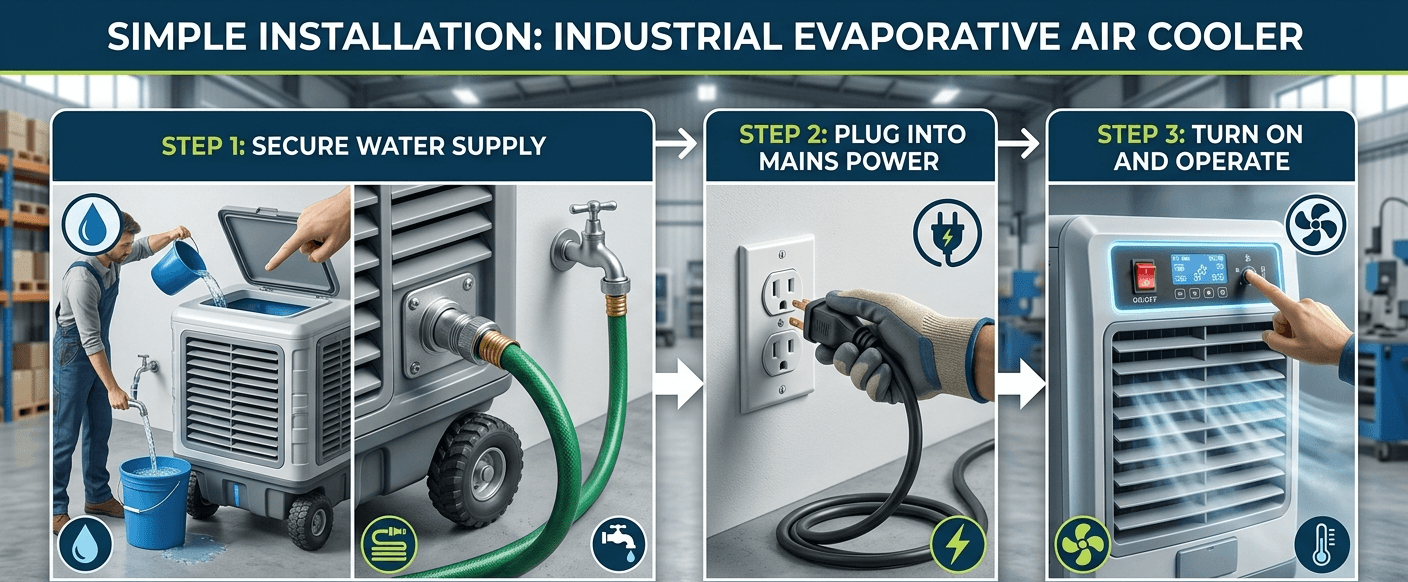
Traditional air conditioners often require major renovations for installation. This is due to most traditional HVAC systems requiring both an inside cooling unit, an outside condenser unit, and outside hoses. Installing these systems requires walls to be drilled into and sections to be removed.
In contrast, evaporative air-cooling systems are mostly plug-and-play. Portable evaporative coolers require nothing more than a water source and a plug point. Provided the space it is being used in has adequate ventilation, you can simply fill up the reservoir, plug the device in, and turn it on.
Evaporative Air Coolers Vs Traditional Air Conditioners | ||
|---|---|---|
Evaporative Cooling Systems | Traditional Air Conditioner | |
Power Use | Typically uses 60% to 90% less power No compressor required | Higher power consumption due to compressor operation Continuous electrical load Much higher running costs |
Running Costs | Lower upfront cost Minimal installation requirements Very low operating costs | Higher upfront cost Installation can be complex Higher operating costs |
Best Suited For | Best for hot climates Ideal for open or well-ventilated spaces Less effective in humid environments | Works in all climates, including high humidity Suitable for enclosed spaces |
Servicing and Maintenance Requirements | Simple maintenance No refrigerant handling Lower servicing costs | More complex maintenance (compressor, coils, refrigerant) Higher long-term maintenance costs |
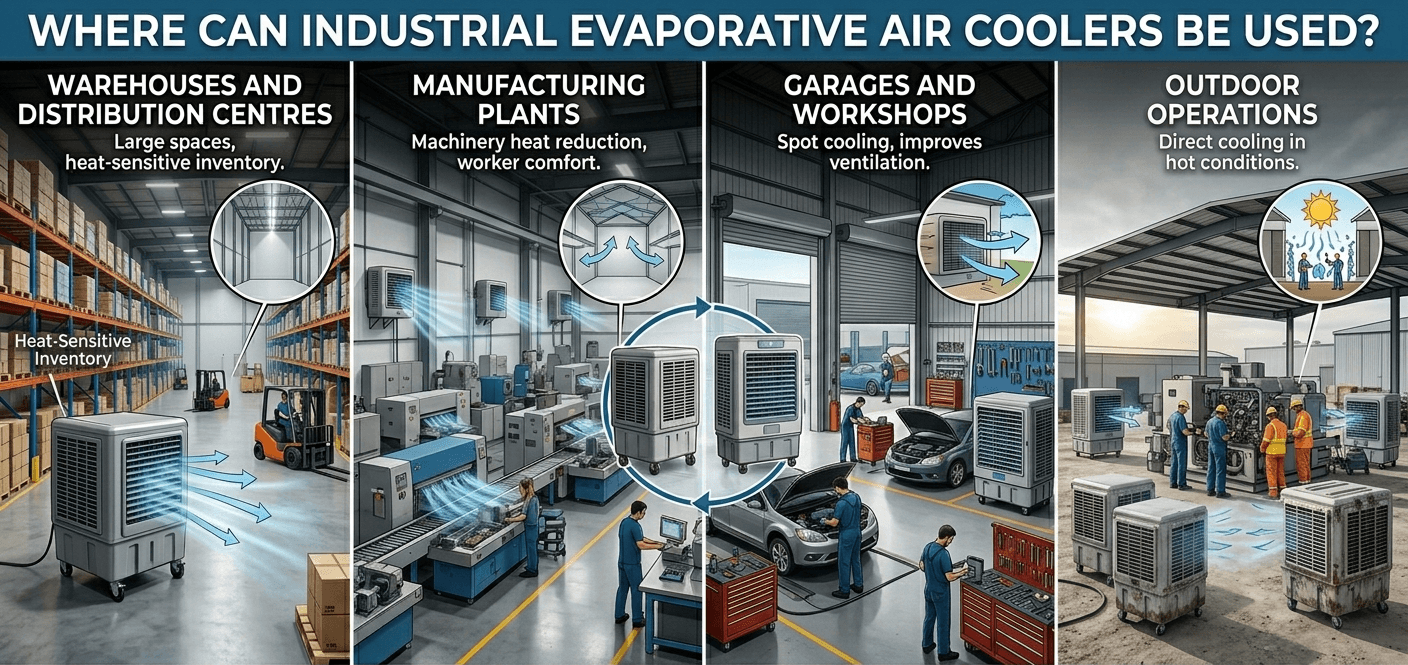
Best Industrial Applications for Evaporative Air Coolers
Warehouses and Distribution Centres
Large Open Spaces – this provides a constant supply of fresh air, which leads to increased evaporative cooling performance.
High Ceilings and Excellent Ventilation – this prevents the buildup of excess humidity, which could affect product quality.
Has lower installation costs when compared to traditional warehouse cooling systems.
Manufacturing Plants
Helps to reduce heat generated during the manufacturing process.
Cooling performance increased in areas that are well ventilated.
Can be integrated with existing ventilation and cooling systems.
Has reduced operating costs, which is perfect for 24/7 manufacturing plants.
Garages and Workshops
Performance better than traditional air conditioning in spaces with high levels of dust and fumes.
Simplicity of design means easier maintenance and reduced serving costs.
Can be installed in small workspaces quickly and easily with no alterations required.
Outdoor Operations
Ideal for spaces where airflow is crucial, such as greenhouses, barns, and livestock areas.
Can easily connect to off-grid power sources.
Effectively controls heat in livestock areas, resulting in lower animal stress.
When Should Evaporative Cooling be Used?
Ideal Climate Conditions
Evaporative cooling solutions rely on high heat and low relative humidity, so it is best to use them in the following areas:
Hot, dry climates.
Areas with low relative humidity.
Well-ventilated areas.
Space Requirements
Provided that the climate conditions are perfect, evaporative air conditioners can be used in either large spaces or smaller spaces. The only special requirements are:
The area must be well ventilated.
Evaporative air coolers must be placed near an open door or window for maximum efficiency.
Evaporative Air Cooler Limitations (When Should They Not Be Used)
Please note that evaporative air coolers should not be used, and be replaced with alternative cooling solutions if:
The area it is being used in has high levels of humidity: Evaporative cooling systems will increase the relative humidity of a space and will work less effectively in areas with already high humidity.
The area is poorly ventilated: Evaporative air coolers cool by drawing in fresh air, and therefore require a constant supply of it. Additionally, poor ventilation will result in the buildup of humidity, which could result in mould and mildew.
Water is scarce: Evaporative air coolers need a constant supply of water to soak the cooling pads. This means the reservoir must always be topped up, or the device must be connected to a water source like a tap.
Choosing the Right Industrial Evaporative Cooler for Your Space
Use the following table as a guide to help you choose the best industrial evaporative cooler for your space.
Evaporative Air Cooler Buying Guide | ||
|---|---|---|
Buying Tip | Recommended Standard | |
Cooling Area Size | Measure the square meterage of the space that needs cooling(m²) | Ensure the airflow (m³/h) matches the space’s size |
Airflow Capacity | Check airflow rating | Small: 1,500–3,000 | Medium: 3,000–6,000 | Large: 6,000+ |
Climate Suitability | Assess humidity levels | Best for dry climates (<60% RH) |
Water Tank Capacity | Check tank size | 20L+ recommended for longer runtime |
Power Consumption | Check wattage | 50–300W typica |
Fan Speeds | Look for a unit with multiple fan speed settings. | Find a cooler with at least 3 fan speeds. |
Features | Look for features that improve usability. | Features like remote control, timer, and swing function improve usability. |
Efficiency | Compare airflow vs power. | Higher airflow per watt is better |
Budget | Compare pricing | Balance cost vs features |
Why You Should Switch to Industrial Evaporative Cooling
Evaporative air-cooling systems offer industrial businesses many benefits. It can help combat the rising cost of energy, assist in meeting sustainability goals and standards, and increase overall operational efficiency. By selecting an evaporative air-cooling system for your industrial business, you are future-proofing your industrial cooling requirements. Unlike most traditional industrial climate cooling systems, evaporative air systems will have a higher cost-saving effect for your business in the years to come. Maintenance costs will be lower, you will pay significantly less upfront costs, and you will not have to worry about replacing expensive refrigerant gas.
To find an evaporative air-cooling solution that suits your industrial needs, browse our range of evaporative air coolers. There you will find a wide range of portable coolers that vary in cooling area, power consumption, and features. We also stock evaporative coolers with infrared technology, which will help maintain clean and healthy air in your manufacturing environment. You can also contact our expert HVAC team today to assist you in picking out a brand new evaporative cooling system for your business.
Frequently Asked Questions About Evaporative Air Coolers
Are industrial evaporative air coolers better than air conditioners?
Industrial evaporative air coolers offer many benefits when compared to traditional air conditioners. These include lower upfront installation costs, less maintenance and servicing, and reduced power consumption.
Are industrial evaporative air coolers cheap to run?
Yes, the reduced power consumption and lower serving costs mean that evaporative air coolers cost less to run than traditional HVAC solutions.
What are the benefits of evaporative cooling for a factory?
Evaporative cooling provides many benefits, including cleaner air, reduced temperatures, and lower running costs.
Are evaporative air coolers environmentally friendly?
Yes, because these coolers use water to cool the air, there are no harmful greenhouse gases emitted during the cooling process.
Are evaporative air coolers noisy in industrial settings?
No, in most cases, evaporative air coolers produce less sound than manufacturing machines and processes.