


What are Portable Air Conditioners and How Do They Work?
Date: 17 May 2022
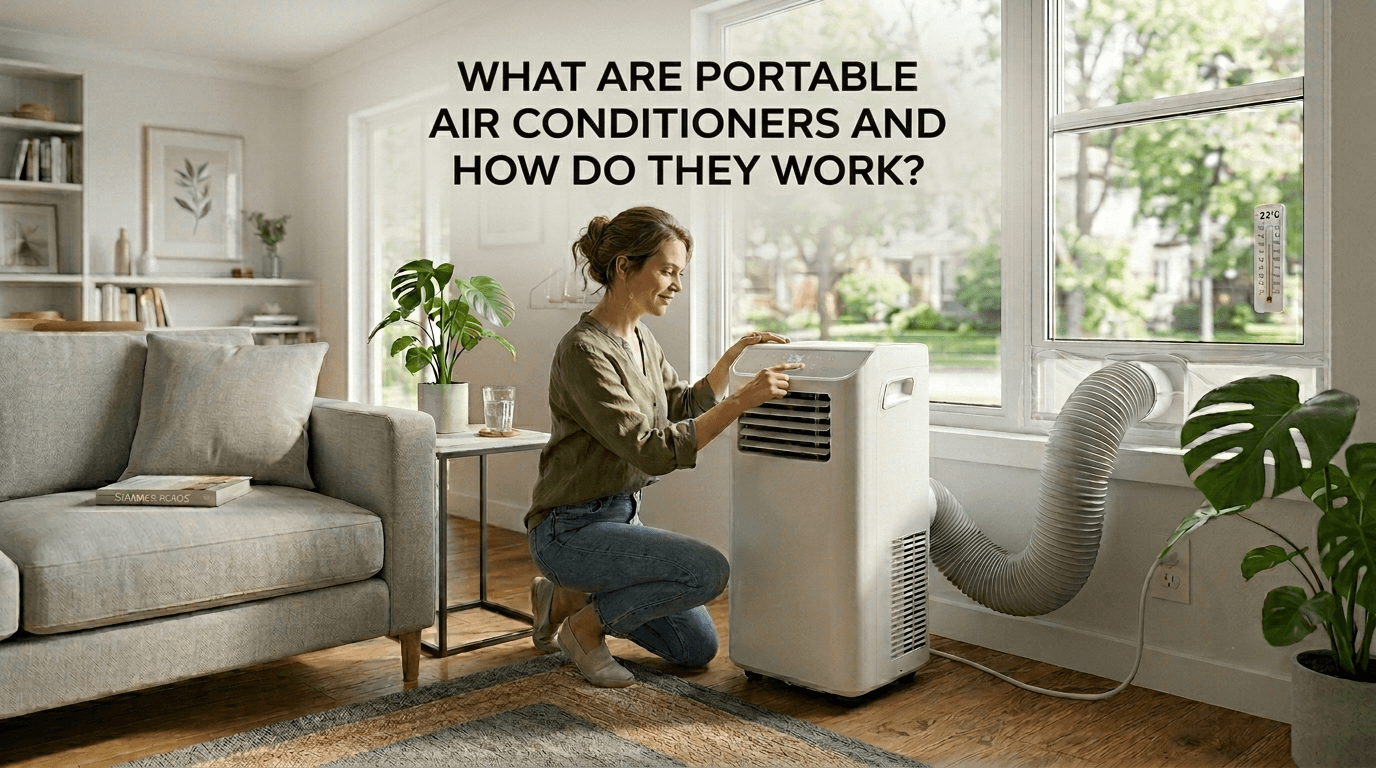
Portable air conditioners are mobile cooling units that can be installed in rooms that need rapid cooling. These mobile cooling units are self-contained, meaning all cooling components are housed in a single case in the room. Unlike traditional cooling fans, portable air conditioners actively reduce the temperature of a space. It does this using a refrigeration cycle, much like traditional wall-mounted or fixed air conditioners. What sets portable air conditioners apart from fixed air conditioners is the fact that no major renovations are needed for installation. This makes mobile AC systems popular cooling solutions for bedrooms, home offices, apartments, and rental properties.
Throughout this article, we will explore portable air conditioners in depth. Part of this exploration will look at how they work, why they need window venting, the benefits of portable AC systems, and their limitations. In addition, we will indicate when portable air conditioners are the right cooling solution for you, and provide practical advice on choosing the best system for your needs.
What Is a Portable Air Conditioner?
Definition of a Portable Air Conditioner
A portable air conditioner is a self-contained cooling appliance that sits on the floor and can be moved from room to room. We say that portable air conditioning units are self-contained because all their major components are housed in a single unit, unlike traditional fixed air conditioning systems, which have both indoor and outdoor units.
Like all other air conditioning systems, portable air conditioners use a refrigerant cycle to cool hot air. It does this using a combination of fans, coils, and a compressor. The cooling process starts by drawing hot air in, passing it through evaporation coils, and then venting it out through the exhaust hose.
Main Components of a Portable Air Conditioner
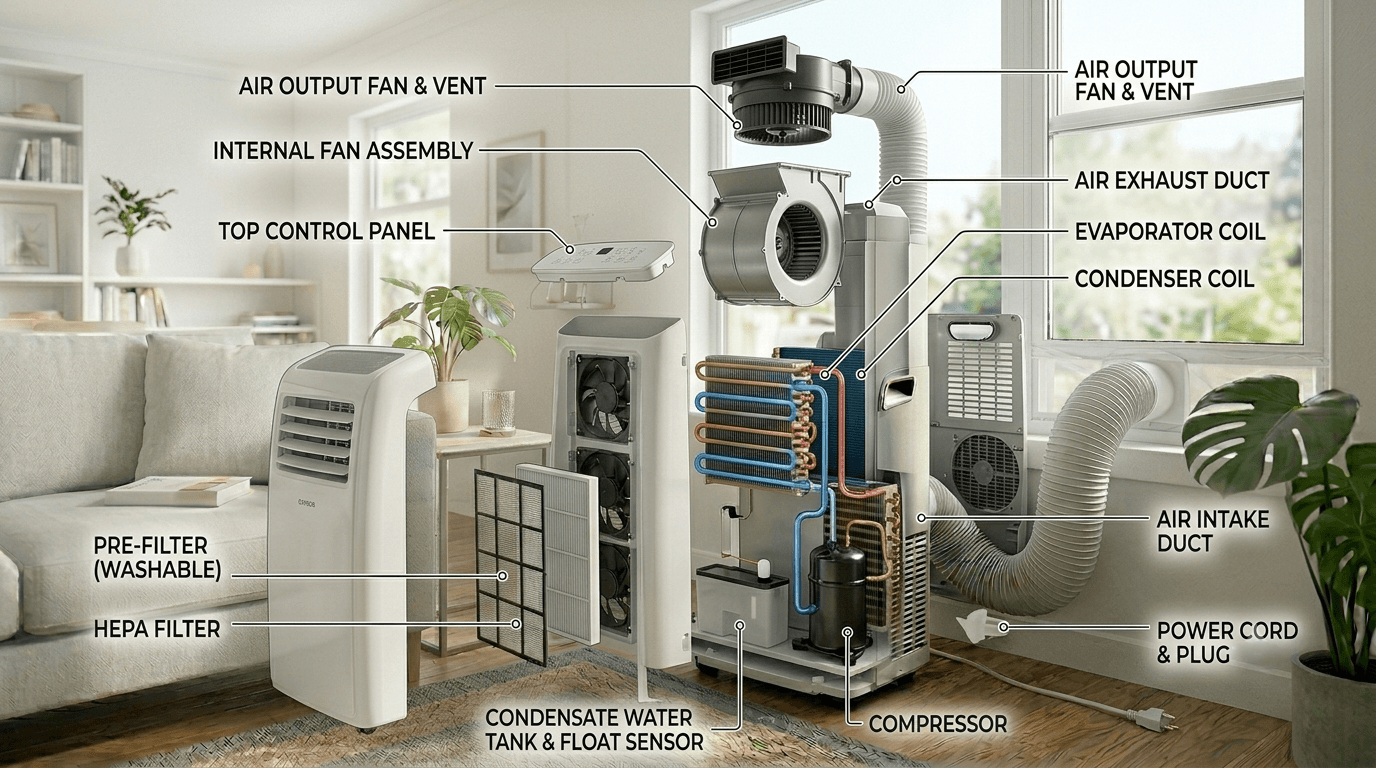
Portable air conditioners are self-contained units. This means that all the major components, listed below, are housed in a single unit. Some of the main components include:
Air Intake: Used to draw warm air from outside into the unit.
Air Filter: Filters out dust and particles from the air before passing it through the cooling system.
Evaporator Coils: Absorbs the heat from the warm indoor air.
Refrigerant: Transfers heat from indoor air to the venting hose.
Compressor: Pressurises refrigerant gas so that it can be released.
Condenser Coil: Release the collected heat via the exhaust hose.
Exhaust Hose: Releases warm air to the outside.
Drainage System: Collects and removes condensation from the system.
Fan: Pushes cool air back into the room.
Common Use Cases
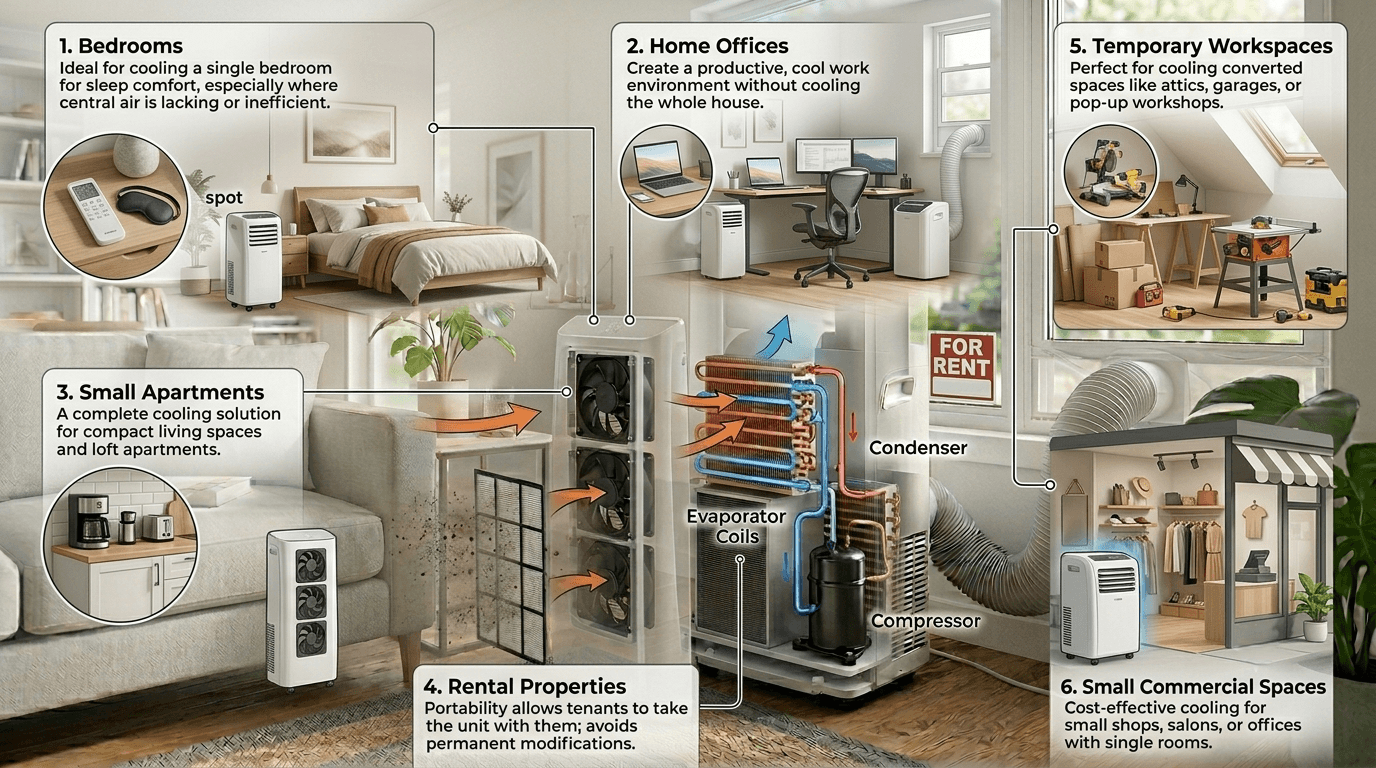
The need for portable air conditioners has arisen due to the rise of small spaces where permanent fixed air conditioning cannot be installed. Some of the most used applications include:
Bedrooms
Home Offices
Small Apartments
Rental Properties
Temporary Workspaces
Small Commercial Spaces
How Do Portable Air Conditioners Work?
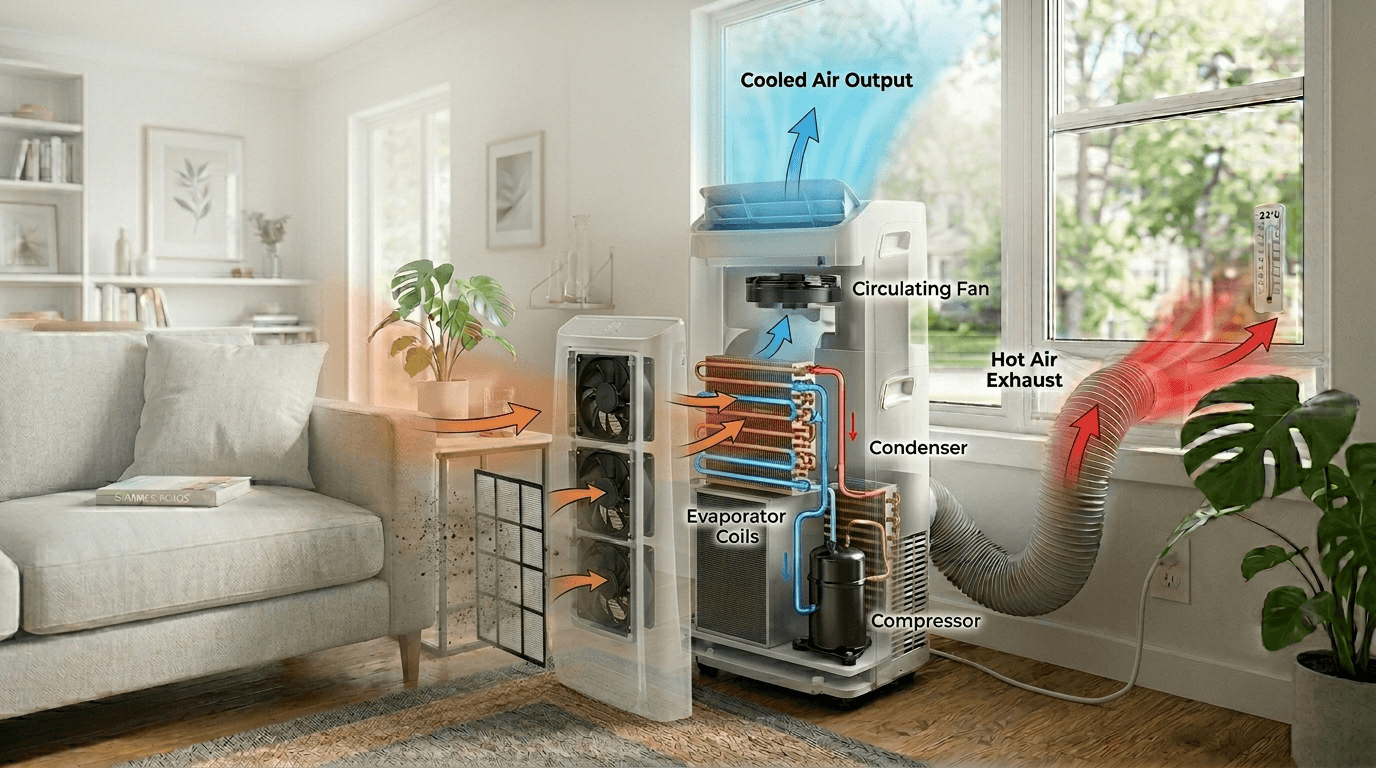
Cooling Process Step-by-Step
Air Intake: A series of intake fans draws warm air into the portable AC unit.
Air Filtration: The warm air drawn in is then passed through a filter, trapping dust and particles before the air is moved on to the cooling process.
Heat Absorption: Refrigerant flowing inside an evaporator coil absorbs heat from the air.
Cool Air Released: The cooled air is blown back into the room using a circulating fan.
Heat Vented Outside: An extraction or exhaust hose expels hot air outside.
The Purpose of Refrigerant
Air conditioning systems, including portable AC units, use special chemicals known as refrigerants to cool hot air. The refrigeration process relies on the principles of pressure and thermodynamics, as the refrigerant cycles between liquid and pressurised-gas states.
Common refrigerants used by modern air conditioning systems include R-410A (Puron), R-32, and R-454B.
The refrigerant is what makes it possible for air conditioners to cool air. Unlike cooling fans that circulate hot air around the room, portable air conditioners use the refrigerant cycle to lower the temperature in a space actively.
Why do Portable Air Conditioners Produce Water?
Water is not actually created during the cooling process. Rather, the water that is collected in a portable air conditioner’s drainage tank is residual moisture left over from the warm air being passed over the much colder evaporator coils.
Warm air naturally contains moisture (also called humidity). When the warmer air interacts with the much colder evaporator coils, the moisture is removed from the warm air and condenses on the coils.
The moisture that collects on the evaporator coils then drains into an internal drainage system or evaporates back into the system to cool the compressor.
What Role Does the Exhaust Hose Play?
Heat Is Removed, Not Destroyed
While portable air conditioners actively lower the ambient temperature by reducing the heat, they do not destroy heat. Instead, heat is transferred from the inside air to the outside air. This transfer is facilitated by an exhaust hose, which is an integral part of the portable air conditioning system. Without the exhaust hose, the hot air would either stay in the room or get trapped in the air conditioning system. If the hot air is not properly vented out of the room, the overall cooling efficiency of your portable AC will be greatly reduced.
Can Portable Air Conditioners Be Used Without a Hose?
The short answer is no, portable air conditioners cannot be used without an exhaust hose. This is because the exhaust hose is integral to the cooling process. True portable air conditioners reduce temperatures by removing heat from the inside. To facilitate this transfer, an exhaust hose is essential.
Running your portable air conditioner can reduce cooling efficiency. This is a direct result of the warmer air that was meant to be extracted staying in the room.
Exhaust Venting Options
• Window Venting Kit
• Sliding Door Kit
• Wall Vent
• Drop Ceiling Venting
• Custom Venting Panels for Unusual Windows
The Difference Between Single-Hose and Dual-Hose Portable Air Conditioners
Single-Hose Portable Air Conditioners
Single-hose portable air conditioning systems, as the name suggests, use a single hose for both air intake and venting. In single-hose systems, hot air is drawn in from the room using an intake fan. It then cools a part of the air drawn in and vents the cooled air back into the room. Some of the indoor air is also used to cool the unit's internal components, namely the compressor. Finally, the heat is vented outside through the single exhaust hose.
It is important to note that single-hose portable air conditioning systems can generate negative pressure. This negative pressure can result in air being sucked in from other rooms and even outside, replacing the newly cooled air with warmer air.
Dual-Hose Portable Air Conditioners
As the name suggests, dual-hose portable air conditioners have two hoses. One is used to draw outdoor air into the unit to cool the condenser, while the other hose is used to vent hot air outside. Thanks to the outdoor air drawn in to cool the condenser, all of the indoor air drawn in through the intake fan is cooled and vented back into the room. The upside of this is that no negative pressure is being created.
Overall, dual-hose systems are regarded as more efficient for cooling larger spaces or in hotter conditions.
Comparing Single-Hose and Dual-Hose Portable Air Conditioners
Feature | Single-Hose Portable AC | Dual-Hose Portable AC |
|---|---|---|
Setup | Easy setup with a single hose and a window venting kit. | More complicated setup with two hoses and a window venting kit. |
Cost | Lower cost. | Higher cost. |
Cooling Performance | Good for smaller rooms | Better for larger or hotter rooms |
Air Pressure | Can create negative pressure | Reduces negative pressure |
Best For | Bedrooms, small rooms, occasional use | Larger rooms, heatwaves, and frequent use |
Portable Air Conditioner vs Other Cooling Methods
Portable Air Conditioner vs Cooling Fan
Feature | Portable AC | Cooling Fan |
|---|---|---|
Setup | Easy setup requiring window kit installation. | Easy assembly is sometimes required; it's plug-and-play. |
Cost | Lower upfront cost compared to fixed | Lowest cost cooling option. |
Cooling Performance | Actively reduces temperature using a refrigerant cycle. | Circulates air around the room. Does not actively reduce the room temperature. |
Best For | Bedrooms, Home Offices, Rental Properties. | Quick and cost-effective cooling. |
Portable Air Conditioner vs Evaporative Cooler
Feature | Portable AC | Evaporative Air Cooler |
|---|---|---|
Setup | Easy setup requiring window kit installation. | Quick and easy plug-and-play setup. |
Cost | Lower upfront cost compared to fixed AC. | Cheaper upfront cost compared to a portable air conditioner. |
Cooling Performance | Actively reduces temperature using a refrigerant cycle. | Actively reduces temperature using the evaporative cycle. |
Best For | Bedrooms, Home Offices, Rental Properties. | Hot and dry climates. |
Portable Air Conditioner vs Wall-Mounted Air Conditioner
Feature | Portable AC | Wall-Mounted AC |
|---|---|---|
Setup | Easy setup requiring window kit installation. | Complex installation and extensive structural modification required. |
Cost | Lower upfront cost compared to fixed AC. | Higher upfront cost. |
Cooling Performance | Actively reduces temperature using a refrigerant cycle. | Actively reduces temperature using a refrigerant cycle. |
Best For | Bedrooms, Home Offices, Rental Properties. | Large Rooms and Commercial Spaces. |
Advantages of Portable Air Conditioners
Easy to Install
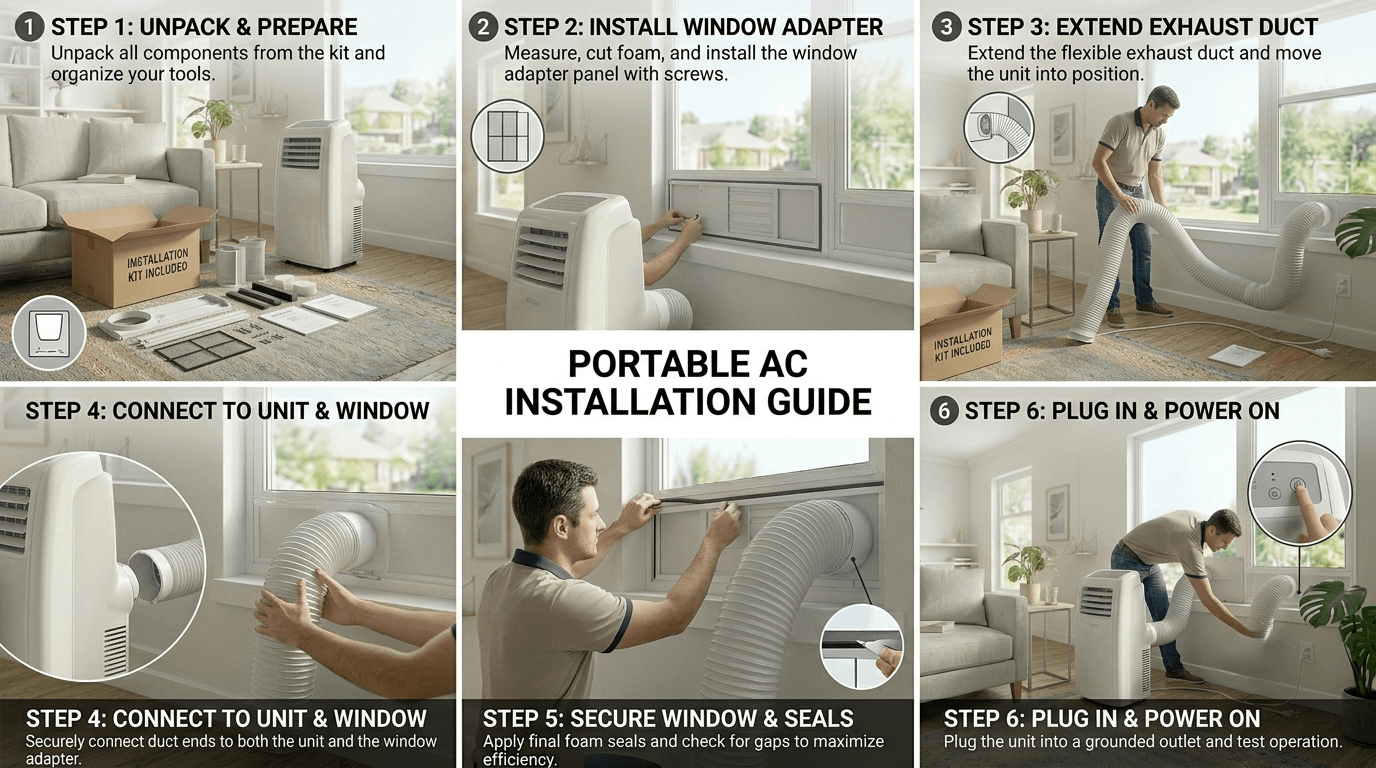
Unlike fixed air conditioners, portable AC units can be purchased and set up with minimal effort. A few features of portable AC units that make this possible include:
Plug-and-Play: Portable air conditioners can be used out of the box. Connect the exhaust hose, plug the unit into the mains, and start using it.
No Permanent Installation Required: The only installation required for a portable air conditioner is the window venting kit. Provided you have the correct kit for your window type, it can be slid into place. It can also be removed when you no longer need the portable air conditioner.
Flexible Cooling
Portable air conditioners provide exceptional spot cooling. It can be used to cool rooms rather than the whole house. This makes portable air conditioners perfect for bedrooms, offices, and temporary spaces.
Perfect for Rental Properties
Renting a property often means that you cannot make major alterations to the building structure. Because of this, fixed air conditioning that requires structural alterations for the cooling pipes and mounting is not possible. Portable air conditioners provide many benefits in this scenario. It requires no building alterations, can be removed when needed, and provides the same level of cooling as fixed air conditioning systems.
Provides Cooling and Dehumidification
Many portable air conditioning models offer multiple modes, including fan, cooling, and dehumidification. The refrigerant cooling cycle is what makes dehumidification possible, as the evaporator coils strip warm air of moisture. This results in a more comfortable atmosphere in hot and humid environments.
Portable Air Conditioning Limitations
Requires Proper Venting
Your portable AC unit must have proper venting, as improper venting will reduce cooling performance. Gaps around the window kit of your portable AC unit can let hot air back into your room, reducing the overall cooling efficiency. When installing the window venting kit, ensure it is properly sealed.
It is also important that your venting hose be as straight and short as possible. A long or twisted hose can reduce venting efficiency, making the unit work less effectively.
Can be Noisy
Portable air-conditioners can be extremely noisy due to them being self-contained units. The reason behind the noise is components, like the intake fans and the compressor. With wall-mounted air conditioners, the compressor is housed in an outdoor unit. Therefore, any noise made by the compressor is not heard inside. Portable air conditioners bring the compressor into the room, housed in the unit with all the other components.
Takes Up Floor Space
To ensure its mobility, portable air conditioners are freestanding units. This means it can be moved around from room to room to provide cooling where it is needed. The freestanding nature of portable air conditioners means they take up floor space, unlike fixed air conditioners, which are mounted against a wall.
Portable Air Conditioner Size Guide
When purchasing a portable air conditioner, size is one of the biggest deciding factors when picking the right portable AC for your space. To determine whether the portable air conditioner you want to buy will be the correct size for your space, you must compare the unit's cooling output (measured in BTU) to the space you need to cool.
What is BTU?
BTU, short for British Thermal Unit, measures the cooling or heating capacity of an appliance. Appliances with higher BTU ratings have greater cooling capacity than those with lower BTU ratings.
General Portable Air Conditioner Sizing Guide
Important note: The above chart is just a general size guideline. Adjustments must be made for environmental factors such as sunlight, insulation, ceiling height, number of people in the room, and heat-generating appliances.
The Best Way to Use Your Portable Air Conditioner
To ensure the maximum lifespan of your portable air conditioner, follow the steps below:
Install the Window Kit Properly
Keep Doors and Windows Shut While Cooling
Clean Air Filters Regularly
Manage Condensation
Are Portable Air Conditioners Worth Buying
Portable air conditioners provide flexible and practical cooling in spaces where traditional fixed air conditioning cannot be used. Like fixed air conditioners, portable air conditioners actively reduce indoor temperature by drawing in warm air from inside, running it through a refrigerant cycle, and then venting excess heat outside.
It is a great cooling solution for anyone needing cooling in temporary spaces, rental properties, or small rooms where wall- or window-mounted air conditioners cannot be installed. While portable air conditioners are not the best cooling solution for every situation, they provide an effective alternative to fixed air conditioning.
If you are looking for a portable cooling solution that is easy to install and will reduce room temperature, check out our portable air conditioner section. To help you choose the best product for your needs, head over to our blog for our portable air conditioner buying guide. For more cooling options, check out our comprehensive selection of cooling products.
Frequently Asked Questions Related to Portable AC Units
What is a portable AC unit?
Portable air conditioners are movable cooling appliances that are designed to cool individual rooms. They are usually self-contained units, meaning that all the cooling components are housed in a single unit inside the room.
How do portable air conditioners work?
They use refrigerant-filled coils to cool warm air drawn from the room. The cooled air is then released back into the room, while heat is vented outside.
Why do portable air conditioners need an exhaust hose?
An exhaust hose is an integral component of portable air conditioners that vents heat outside. Without an exhaust hose, the cooling efficiency of the portable air conditioner would be greatly reduced.
Can portable air conditioners be used in rooms with no windows?
Yes, but only if you have an alternative way to vent hot air outside. Alternative venting options include a sliding door kit, a wall vent, or an external opening.
Are portable air conditioners and evaporative air coolers the same?
No. While both systems are mobile cooling options, they use different cooling methods and work in different climates. Portable air conditioners use the refrigerant cycle to cool and work best in hot and humid environments. Evaporative air coolers use the cooling effect of evaporation and work best in hot, dry environments.
Are portable air conditioners expensive to run?
The cost to run a portable air conditioner is dependent on the unit’s power consumption, efficiency, and BTU rating. Other factors that affect operating costs include the local electricity rate and the number of hours per day you use the portable air conditioner.