


Buying Guide for Evaporative Air Coolers
Date: Invalid Date
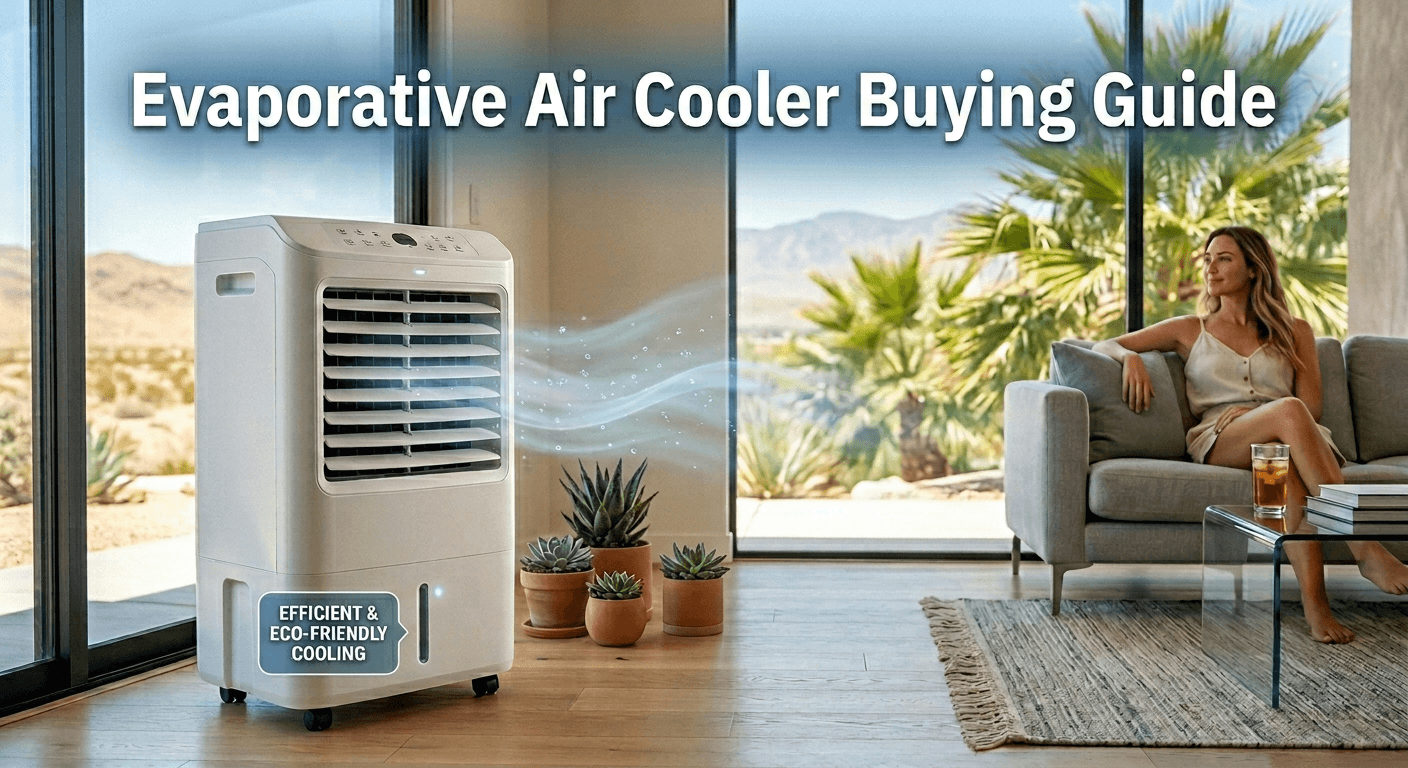
Evaporative air coolers (also known as swamp coolers) are cost-effective cooling appliances for both residential and commercial use. They work where traditional air conditioners cannot be installed. Portable evaporative coolers can be used in indoor and outdoor spaces, provided there is sufficient airflow. Because of their versatility and cost-effectiveness, evaporative coolers are becoming a popular cooling option for homeowners and commercial customers.
With all the benefits evaporative cooling offers, you must buy the right evaporative cooling system for your needs. Purchasing the wrong unit could leave you with an inefficient cooling system that does not work for your home or office.
Benefits of Buying an Evaporative Air Cooler
Energy Efficiency
Evaporative air coolers are simple electrical appliances that require small amounts of energy to power intake and venting fans and a water pump. Coolers of this kind use much less electricity when compared to traditional air conditioning units, which require large amounts of electricity to power compressors and condensers.
On average, evaporative air coolers use 75% to 90% less energy than traditional air conditioners. What this translates to is a unit that uses 20W to 150W for evaporative air coolers (depending on the model), compared to 1000W+ for traditional air conditioners (depending on the model).
Sustainable Cooling
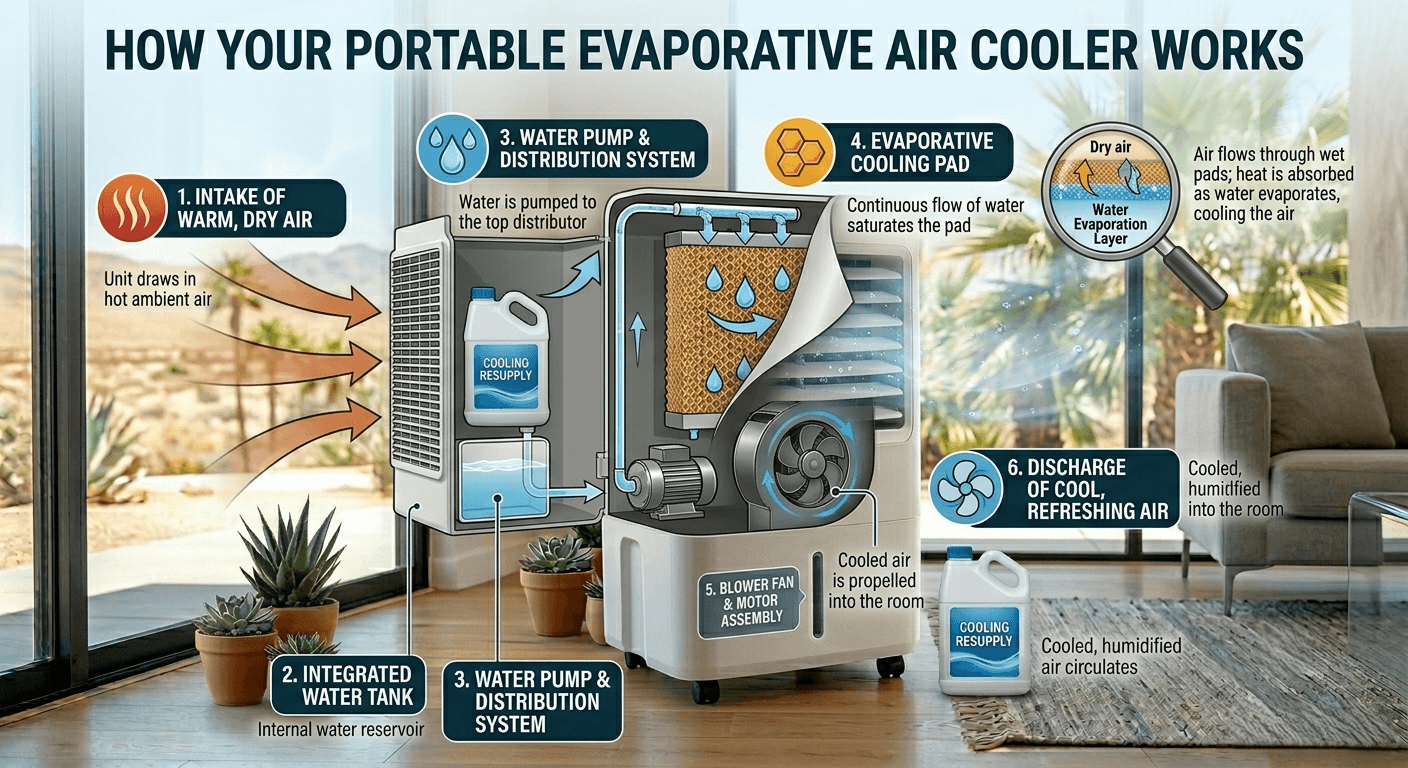
Evaporative air coolers have a lower carbon footprint than air conditioning systems. This is because evaporative air coolers do not use refrigerant gas, which leads to the creation of harmful greenhouse gases. Instead, the whole cooling process is powered by water. Humidity and condensation are the only byproducts of an evaporative air cooler’s cooling process.
Portability and Versatility
Evaporative air coolers are highly portable thanks to the addition of strong caster wheels. Because no permanent installation is required, evaporative air coolers can be used wherever there is a plug point and a water source. Evaporative air coolers require a constant flow of fresh air to operate optimally, making outdoor areas like covered patios and terraces the perfect areas to cool.
Improved Air Circulation
Using an evaporative air cooler has the added benefit of increasing the flow of fresh air where the cooling appliance is used. When an evaporative air cooler is used in a space, doors or windows must be left open so that a stream of fresh air can fill the room. This fresh air is what the evaporative air cooler draws in and cools, later venting cool air into the room. An additional benefit of this constant flow of fresh air is that it can create a cross-breeze, which increases the cooling effect.
Potential Usage Limitations of Evaporative Air Coolers
Evaporative Air Coolers are Less Effective in Humid Conditions
Evaporative air coolers cool the air by filling it with moisture. It does this by using the cooling effect of evaporation. Because of this, a room cooled with an evaporative air cooler will end up being more humid. This works extremely well in hot and dry conditions, where the humidity levels are low. It works less effectively in areas where humidity is high.
For the maximum cooling effect, it is recommended that an evaporative air cooler be used in climates with less than 40% humidity. Above 50% humidity, the cooling efficacy lessens and becomes almost completely ineffective in humidity that is above 60%
Provides Less Accurate Cooling and Temperature Control than Air Conditioning
Unlike air conditioning systems, evaporative air coolers do not have thermostats. The amount of cooling is determined by how much evaporation takes place and how much humidity the air can absorb. This means that the existing humidity levels are a major constraint that limits the cooling power of an evaporative air cooler.
Requires Regular Maintenance to Run Optimally
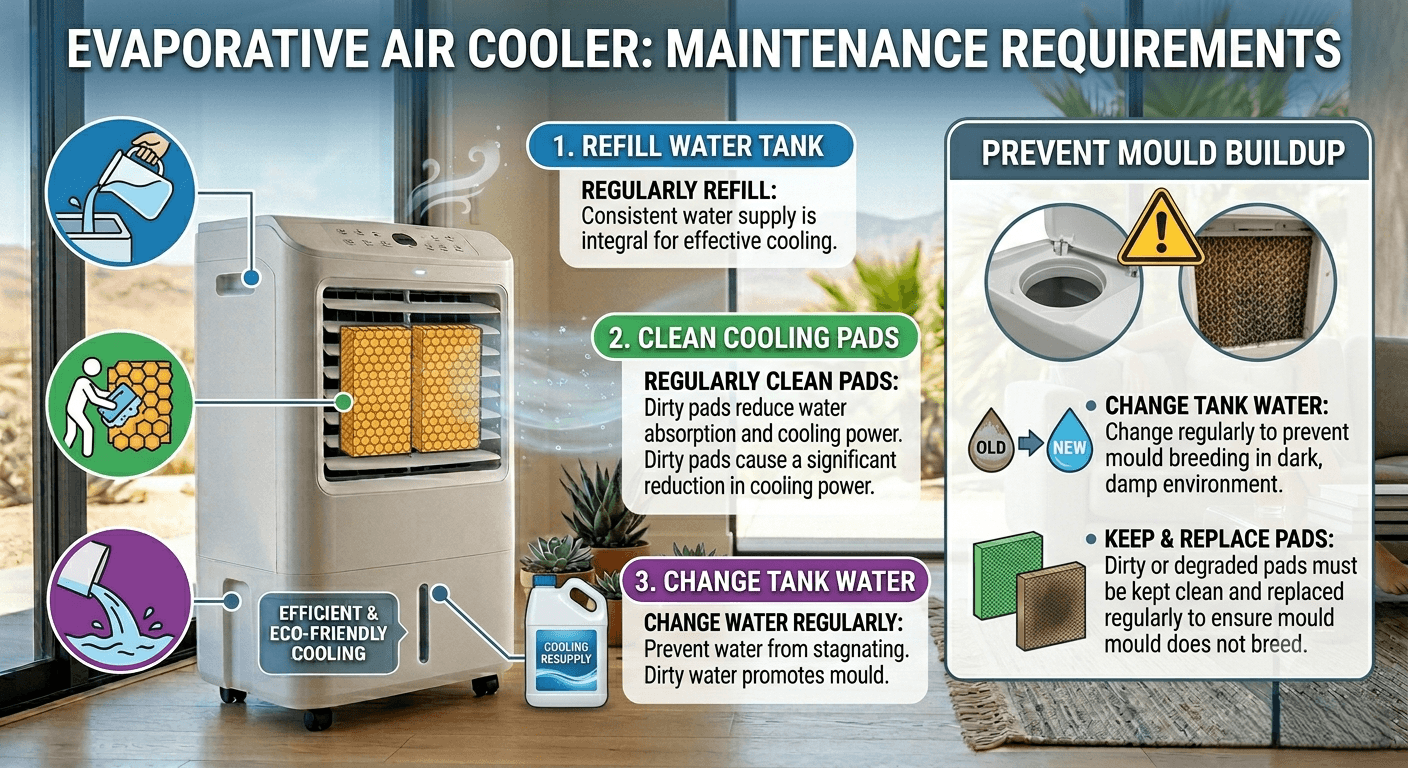
Evaporative air coolers require regular maintenance to ensure optimal performance. The maintenance requirements of evaporative air coolers are as follows:
The appliance’s water must be refilled if it has a water tank. Water is an integral part of the cooling process, and the appliance must have a consistent supply of water to work effectively.
The cooling pads must be cleaned regularly. Evaporation occurs when hot air interacts with the water-soaked cooling pads. Dirty cooling pads will not absorb water as efficiently as clean cooling pads, causing a significant reduction in the appliance’s cooling power.
Because of the presence of water and humidity within the evaporative air-cooling system, mould becomes a major issue. Mould occurs in evaporative air coolers when water is left in the water tank for too long. The dark and damp environment creates a perfect breeding ground for mould. To prevent this, the water in the tank must be changed regularly. Another cause for mould buildup is dirty or degraded cooling pads. Cooling pads must be kept clean and replaced regularly to ensure mould does not breed in the appliance.
Types of Evaporative Air Coolers
Portable Evaporative Air Coolers
These are portable air conditioners that generally feature caster wheels that allow you to move from room to room. Portable air conditioners are ideal for apartments and spaces where a fixed cooling system cannot be installed.
Window-Mounted Evaporative Air Coolers
These are larger, fixed evaporative air-cooling systems that are designed to cool larger areas by facilitating a greater airflow. Window-mounted evaporative air coolers are ideal for large commercial spaces, workshops, and industrial areas.
Whole-House Evaporative Air-Cooling Systems
These are ducted cooling systems that are integrated into your home’s HVAC system and infrastructure. Whole-house evaporative air-cooling systems are ideally used as central cooling systems for large homes.
Outdoor Evaporative Air Coolers
These are often portable evaporative air coolers that are designed to work optimally in outdoor spaces. Outdoor evaporative air coolers are ideal for bars and restaurants with open patios and terraces.
Key Features to Consider Before Buying
Room Size
The first thing you need to think about before purchasing an evaporative air cooler is the size of the room you want to cool and the air flow in that room. Knowing an evaporative air cooler’s CFM (cubic feet per minute) and matching that value to the size of the room will give you an accurate idea of what size evaporative air cooler you need.
To keep things simple, we have developed a simple evaporative air cooler size calculator that you can use. Simply insert your room dimensions, and the calculator will determine what size evaporative air cooler you need.
Water Tank Capacity
The larger the water tank, the longer the appliance will run and cool. For small rooms and bedrooms (up to 15 m2), a water tank of 4 to 7 litres is big enough. Larger rooms (20 to 50 m2) require a 1 to 15 litre water tank.
Fan Speeds and Cooling Modes
Evaporative air coolers do not have thermostats like air conditioners. Instead, cool air is blown into the room using a series of fans and vents. Units with adjustable fan speeds and settings allow you to control the amount of cold air that is vented from the evaporative air cooler. While you can’t control the exact temperature in the room as you can with air conditioners, variable fan speeds on evaporative air coolers give you a choice of various cooling modes.
Noise Levels
While evaporative air coolers are generally quieter than air conditioners, they are not silent. The noise coming from an evaporative air cooler can be characterised as background white noise when being operated at low fan speeds. At higher fan speeds, the evaporative air cooler starts to get noisier, often making it difficult to hear other devices such as a television.
Portability and Mobility
When buying a portable evaporative air cooler, make sure the caster wheels are robust enough for heavy use. Also, look for wheels that rotate 360 degrees. This will ensure that the evaporative air cooler is highly portable and easy to move. Evaporative air coolers get heavy when the water tank is full, so wheels that provide easy manoeuvrability are an important feature to look out for.
Air Filtration Features
Modern evaporative air coolers can do much more than cool air. Units found on the market today are equipped with air filters that filter dust and harmful particles out of the air as it passes through the unit. These filters are usually made from either multi-layer carbon or mesh dust and work alongside the evaporative pads to deliver cool, fresh air.
What Size Evaporative Air Cooler Should You Buy?
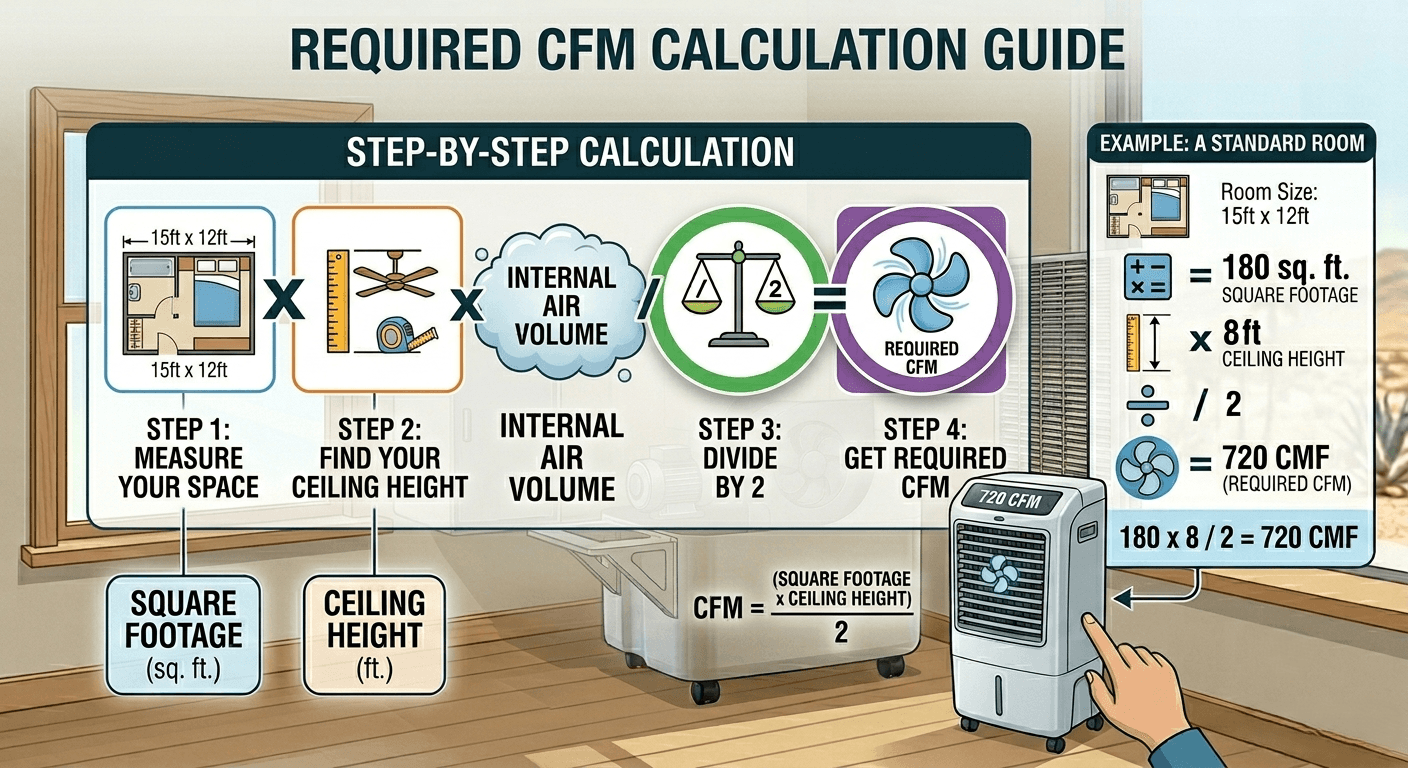
One of the first questions you should ask before buying an evaporative air cooler is, “What size evaporative air cooler do I need?” The easiest way to determine what size unit you need is to calculate what the required CFM for your space is.
To calculate the required CFM for your space, you need to multiply the square footage of your room by the height of your ceiling and then divide that number by 2.
An example of this calculation would look as follows: if you have a room that measures 15 feet by 12 feet (180ft square footage) with an 8-foot ceiling, your equation would be 180 X 2 / 2 = 720 CMF.
Recommended CFM Based on Room Size
• Small Rooms (Up to 200 sq. ft.): 500 to 1200 CFM
• Medium Rooms (200-500 sq. ft.): 1500 to 3000 CFM
• Large Areas and Outdoor Spaces (500+ sq. ft.): 4000 – 7000 CFM
Best Use Cases for Evaporative Air Coolers
Indoor
Bedrooms
Living Rooms
Offices
Outdoor
Garages
Workshops
Outdoor Entertainment Areas
Common Mistakes Buyers Make
Buying the Wrong Size Unit: A unit that is too small for the space you are using it in won’t cool the room efficiently. Instead, your unit will be running non-stop with very little cooling effect felt.
Using the Unit in a Humid Environment: Evaporative air coolers naturally work less effectively in humid environments because the unit adds moisture to cooled air, increasing the latent humidity in the room. Fresh, dry air is needed to facilitate evaporation and trigger the cooling effect.
Not Ventilating Enough: To get the supply of dry air required to trigger the cooling effect of evaporation, the unit must be used in a well-ventilated space. In addition to reducing cooling efficacy, a lack of proper ventilation will also lead to a buildup of moisture, which can result in mould and other issues.
Buying Based Only on Price: While it might be tempting to buy the cheapest unit available, it is not guaranteed to meet your cooling requirements. Cheaper units are also sometimes poorly made with low-quality cooling pads and flimsy construction. Inversely, it could also be tempting to buy the most expensive unit, thinking it might be the best. It is not necessary to buy a large, expensive unit when a smaller, more affordable unit can do the job.
Neglecting Maintenance: Not emptying the water tank when the unit is not in use can result in the buildup of mould and scale in the unit. Both these issues can reduce cooling efficacy and cause unpleasant odours to vent out of the unit.
How Much Does It Cost to Run an Evaporative Air Cooler?
Electricity Cost
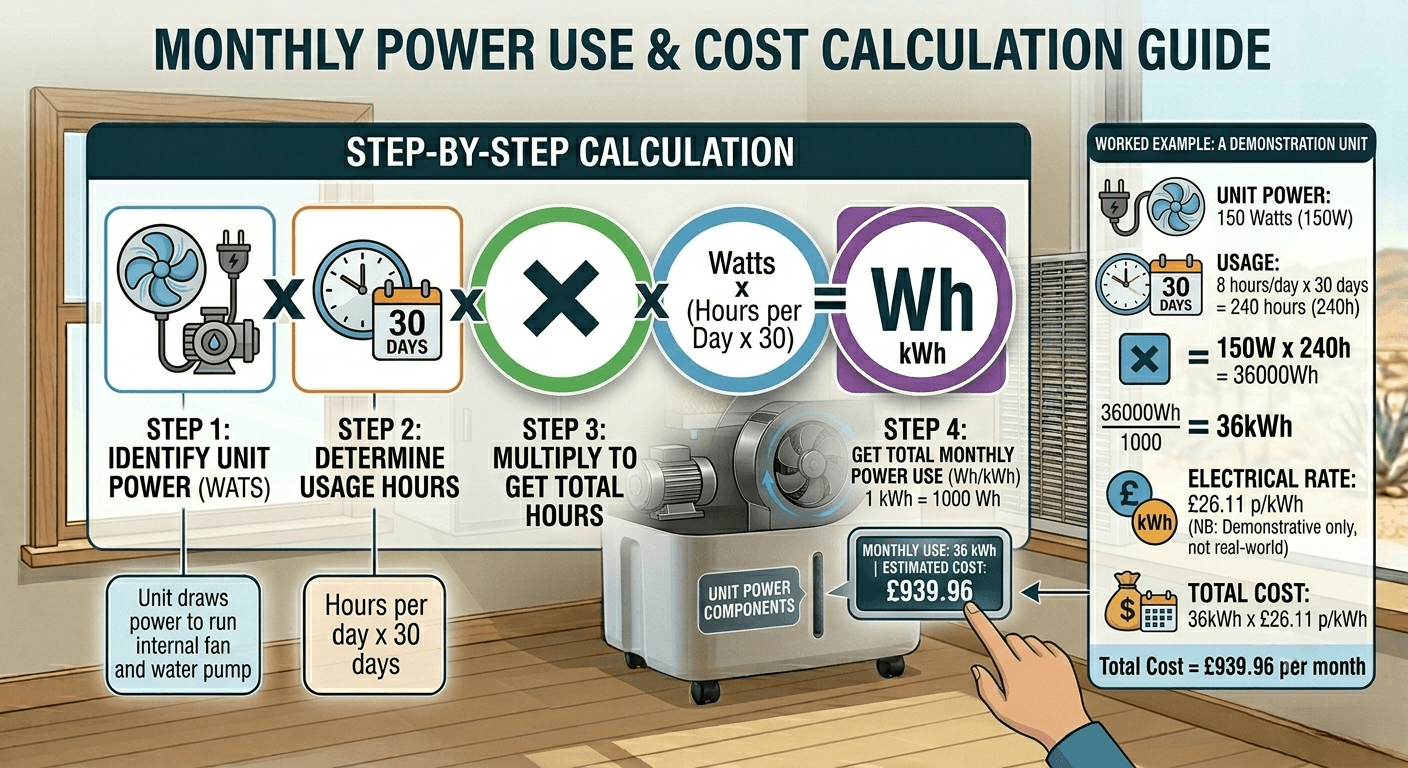
The exact electricity cost is dependent on the regional utility price per kWh. A simple calculation you can use to determine what the total electricity cost for a unit might be is as follows: Monthly Power Use X Utility Rate per kWh.
To determine the Monthly Power Use of your unit, simply multiply how many watts the unit uses to power its fan and internal pump by the number of hours you will be using it for: Monthly Power Use = Unit Power Use x (hours per day X 30)
Let’s say you have a unit that uses 150 Watts of power to run, and you use it for 8 hours a day for 30 days (a total of 240 hours) at £26.11 p/kWh. Your calculations would look like this:
Monthly Use = 150W x 240h = 36000Wh = 36kWh
Total Electrical Cost = 36kWh x 26.11 p/kWh = £939.96 per month
(NB. Totals are for demonstrative purposes only and do not represent real-world scenarios)
Water Usage
A typical indoor evaporative air cooler uses up to 45 litres of water per 8-hour usage day. Considering an average price of 0.5p per litre, you are looking at an average of £22.50 per month.
(NB. Totals are for demonstrative purposes only and do not represent real-world scenarios)
Buying Guide Checklist
Use this handy checklist to ensure you buy the right evaporative air cooler based on your needs.
Factor | What to check | Yes / No |
|---|---|---|
Climate | Is the relative humidity where you are using the unit below 50% to 60%? | |
Unit Size | Does the unit’s CFM rating match the required CFM of your room? | |
Tank Size | Is the water tank big enough to run for the duration you intend to use the device? | |
Noise Requirements | Does the noise level of the unit meet the requirements of your space? | |
Features | Does the unit have helpful features like multiple fan speeds, a sleep timer, and reusable filters? | |
Mobility | Does the unit have strong, movable wheels? | |
Ventilation | Is the room you are using the unit in well-ventilated? |
Final Buying Advice for Buying an Evaporative Air Cooler
Evaporative air coolers are great alternatives to traditional air conditioning, especially in hot and dry environments. Before selecting an evaporative air cooler, you need to determine what size unit you need, the features that you will benefit from, and how long you intend to use the unit each day. These key questions will help guide you in purchasing the right unit for your needs.
Once you have determined what kind of evaporative air cooler you need, we recommend that you head to our evaporative air coolers product page. There, you can easily add the unit you need to your cart, and after a simple check-out process, your new evaporative air cooler will be on its way to you.
For additional information and resources, you can contact us, and one of our HVAC specialists will gladly assist you with everything you need. If you need other cooling options, check out our cooling shop, where you will find great options like cooling fans, portable air conditioners, and packaged terminal air conditioners.
Frequently Asked Questions about Evaporative Air Coolers
Do evaporative coolers need ventilation?
Yes. You must keep a nearby window or door open to circulate moisture-filled air out of the room; otherwise the air will become saturated, and the cooling effect will stop.
How much electricity does an evaporative cooler use?
Most standard portable models pull between 60 Watts and 250 Watts of power during standard operation. This is roughly the same amount of electricity required to run a standard household ceiling fan, and a fraction of what an AC demands.
How often should I clean my evaporative cooler?
You should drain the reservoir and wipe down the water tank every two to three weeks during periods of heavy seasonal use. A more thorough, deep mechanical cleaning and pad inspection should be performed annually before winter storage.
Are evaporative coolers safe for bedrooms?
Yes, they are completely safe. Many portable residential models offer specialised ultra-quiet fan motors, dimmed display options, and built-in automatic shut-off timers tailored specifically for overnight bedroom use.
Do evaporative coolers increase humidity?
Yes, they intentionally add moisture to your indoor air as a natural byproduct of the cooling process. This is excellent for hot and dry environments, but makes them inefficient in already muggy climates.
How long do evaporative coolers last?
With basic care, routine cleaning, and proper off-season storage, a high-quality residential evaporative cooling appliance will easily last between 5 and 10 years.