


Air Conditioning vs Evaporative Cooling: Which is the Best Cooling Solution for You
Date: 9 May 2022
Why Choosing the Right Cooling System is Important
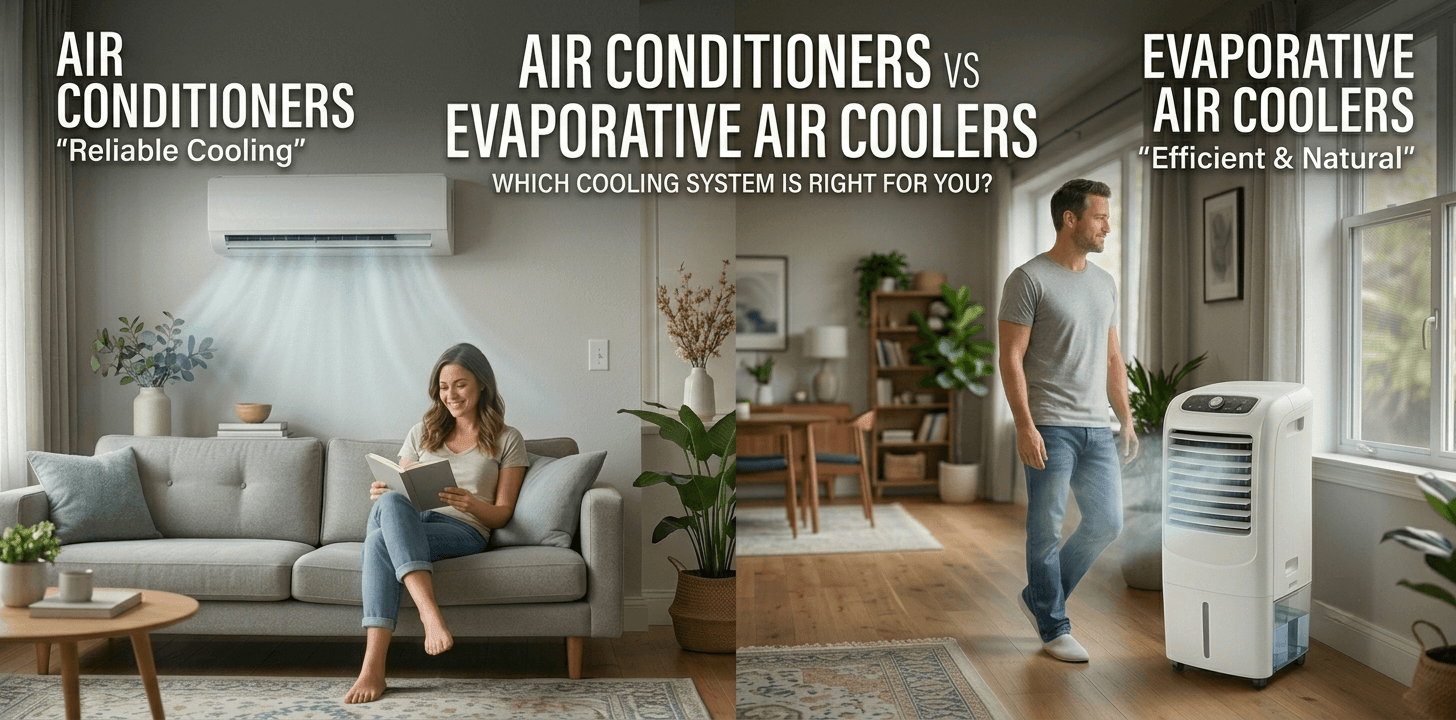
In the current cooling appliance market, two cooling systems dominate. Air conditioning and evaporative cooling. Both are very effective cooling systems, but how do you decide which one is the right cooling solution for you?
When debating about air conditioning vs evaporative cooling, there is no definitive answer about which is better. Rather, the best cooling solution is dependent on your needs. Air conditioning and evaporative cooling provide cooling through different processes. They are also more effective in different conditions and environments.
Air conditioning cools warm air using the refrigerant cycle and works best in indoor spaces that require a strong, controlled supply of cold air. They consume more energy than evaporative coolers but work better in hot and humid environments.
Evaporative air coolers (also known as swamp coolers) are simple cooling appliances that cool air using the natural cooling effect of evaporation. These are best suited for hot, dry environments. Evaporative air coolers add humidity to the air, which increases overall comfort.
Quick Comparison Guide for Air Conditioners and Evaporative Air Coolers
Feature | Air Conditioning | Evaporative Air Cooler |
|---|---|---|
Cooling method | Cools air with refrigerant gas. | Cools air using the natural cooling effect of evaporation. |
Application | Closed spaces Humid climates Offices Homes | Spaces with lots of ventilation. Hot and dry climates. Rental apartments. Outdoor areas. |
Energy use | High energy use. | Low energy use. |
Running Cost | High upfront running costs. | Low upfront and running costs. |
Humidity Effect | Lowers moisture in the air by drying it. | Increases moisture in the air. |
Ventilation requirements | Must be used in closed spaces with no ventilation. | Must be used in spaces with lots of ventilation. |
Installation | Professional installation is required. | Simple plug-and-play design means no professional installation is required. |
Maintenance | Filters Coils Refrigerant checks Regular servicing | Water tank Pads Filters Cleaning |
When Should You Pick Air Conditioning and When Should You Pick Evaporative Air Cooling
Choose air conditioning if you need:
Strong and consistent cooling.
Cooling in humid environments.
Cooling in spaces with no ventilation
Choose evaporative air cooling if you need:
Energy-efficient cooling.
Cooling in hot and dry conditions.
Cooling in well-ventilated areas.
What Is an Air Conditioner?
How an Air Conditioner Works
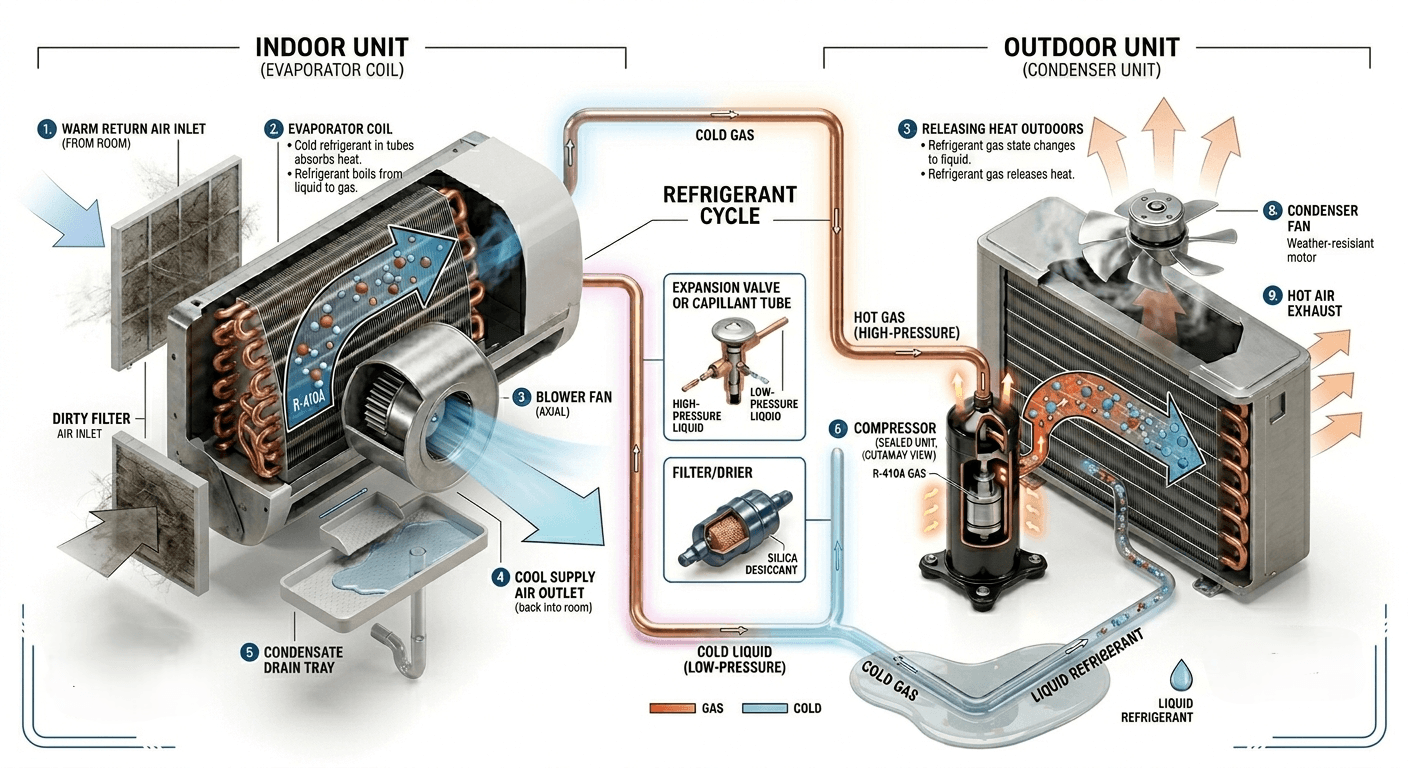
Air conditioners draw in warm air from your room. That warm air is then passed over metal coils chilled by refrigerant gas. As the warm air passes over the metal coils, the heat transfers into the refrigerant gas. The cool air that remains is then blown back into the room, while the heat is removed through a vent or an exhaust hose.
What Is an Evaporative Air Cooler?
How an Evaporative Air Cooler Works
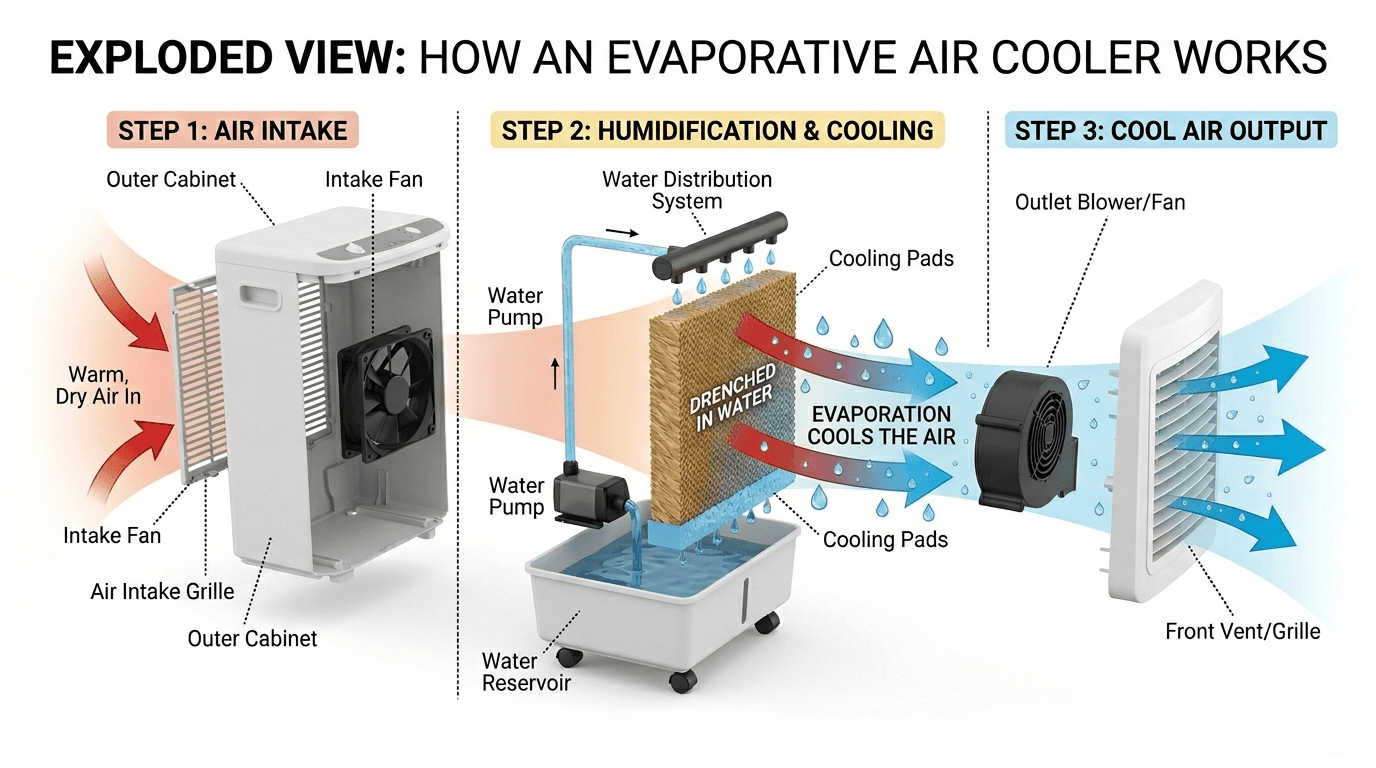
Like air conditioners, evaporative air coolers start by sucking warm air in from your room. That warm air is then passed through cooling pads soaked in water. Evaporation occurs when the warm air passes through the cooling pads. This evaporation causes the air temperature to drop. As evaporation takes place, the newly cooled air is filled with moisture. The cooled air is then blown back into the room by the fans.
What Separates Air Conditioners from Air Coolers
Refrigeration vs Evaporation and Airflow
Air conditioners use a refrigeration cycle to remove heat from indoor heat. In this cycle, a compressor is used to pump and pressurize the refrigerant gas through metal coils. Warm air drawn in from your room is passed over the metal coils, which are cooled by the refrigerant gas. Air conditioning systems provide the benefit of reducing both the temperature and humidity, which is beneficial in hot and humid conditions.
Evaporative air coolers rely on the flow of fresh air and the cooling power of evaporation to cool a space. This process does not require a compressor or refrigerants, making it more energy efficient and environmentally sustainable. The only requirements for cooling are a steady stream of fresh air and a water supply. Because air coolers use evaporation to cool air, they add some humidity to the cooled air, making them a great cooling solution for hot, dry environments. This added humidity also means that air coolers can be used in well-ventilated areas.
Why This Difference Is Important for Buyers
There are a few reasons why the difference between air conditioners and air coolers matters for buyers.
Cooling Performance
Due to their different cooling methods, air conditioners and air coolers perform optimally under different conditions.
Air conditioners work best in hot and humid spaces. During the cooling process, humidity is removed from the air, leaving cool and dry air. The cooling performance of air conditioners is strongest when used in a closed room.
Evaporative air coolers work best in hot and dry spaces. As the warm air passes through the water-soaked cooling pads, evaporation fills the air with humidity. This leaves a stream of cool and moisture filled air that increases comfort. The cooling performance of evaporative air coolers is strongest when there is a constant supply of fresh air.
Energy Consumption
Air conditioning units are traditionally less energy efficient than evaporative air coolers. Components such as the compressor and condenser in air conditioners require large amounts of power. Air coolers are much simpler electric appliances, consisting of fans and pumps that consume much less power.
Running Costs
Air conditioners usually have higher running costs than evaporative air coolers. On average, air conditioners can consume anywhere from 1000 watts for small portable units to 3500+ on larger split systems. This higher power consumption means higher electricity bills at the end of the month.
Installation Requirements
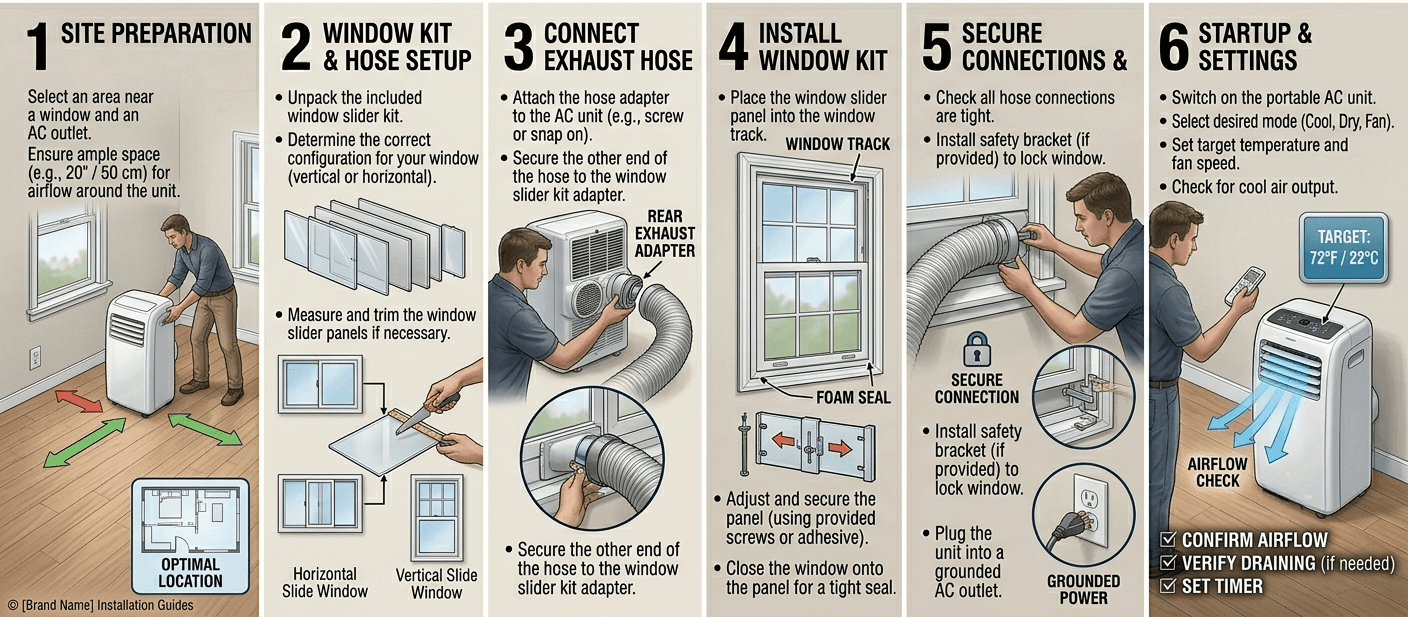
Air conditioning systems require more complex installations than air coolers. Wall-mounted, fixed, and split air conditioning systems all require major structural modifications and the installation of both indoor and outdoor units. Portable air conditioning systems require a window venting kit to exhaust heat outside.
Air coolers are much simpler electrical appliances that do not require extensive installation. Generally, portable evaporative coolers require only that you fill the water tank and connect the unit to the mains.
Cooling Comfort
Air conditioners provide you with the most accurate temperature control. It cools the air by removing moisture, leaving you with dry, precisely cooled air.
Evaporative coolers provide better airflow as air coolers require proper ventilation to perform optimally. This means rooms cooled with an air cooler always have a fresh breeze and are more comfortable in dry climates.
Which Cooling Method Provides Better Cooling
Air Conditioning: Best Temperature Control Solution
The need to keep doors and windows shut when using an air conditioner allows you to control the room temperature more accurately. This makes air conditioning a better cooling solution for users and situations requiring exact room temperatures.
Evaporative Coolers: Fresh Cooling in Dry Environments
In exceptionally hot and dry conditions, evaporative air coolers can provide better cooling. This is in part due to evaporative air coolers adding humidity to the cooled air, increasing indoor comfort when it is hot. Another reason evaporative air coolers work better in hot, dry conditions is that they require a constant supply of fresh air.
Air coolers are best used in spaces and conditions where it is impractical or too expensive to use air conditioners.
Climate Determines the Best Cooling Solution
The biggest deciding factor in choosing a cooling solution is the climate. Air coolers and air conditioners both work optimally under different conditions and in different environments. As a rule, we suggest that you follow these guidelines:
Evaporative air coolers work more effectively in hot and dry conditions with a steady supply of fresh air.
Air conditioners work more effectively in hot and humid environments and require enclosed rooms.
Running Costs and Energy Consumption
Electricity Usage
High Use – Air conditioners consume more electricity because they have more components that use large amounts of energy. These components include compressors, heat pumps, and condensers.
Low Use - Evaporative air coolers are much simpler electrical appliances that consume much less energy. Most evaporative air coolers only use fans, pumps, and water systems, which consume much less electricity.
Factors Influencing Running Cost
The size of your cooler
Local electricity pricing
How long you use the cooler
The size of your room
The climate you are using the cooler in
How well your space is ventilated
How well you maintain your cooler
The degree of temperature reduction required
Installation Requirements
Air Conditioning Installation
Split and Ducted Air Conditioners
Split and ducted air conditioning systems require professional installation, as they often require extensive building alterations. These types of air conditioning units require special wall mounting, ducting, drainage, and electrical work. Upfront installation costs for fixed air conditioning systems are generally higher than those for portable AC systems or evaporative coolers.
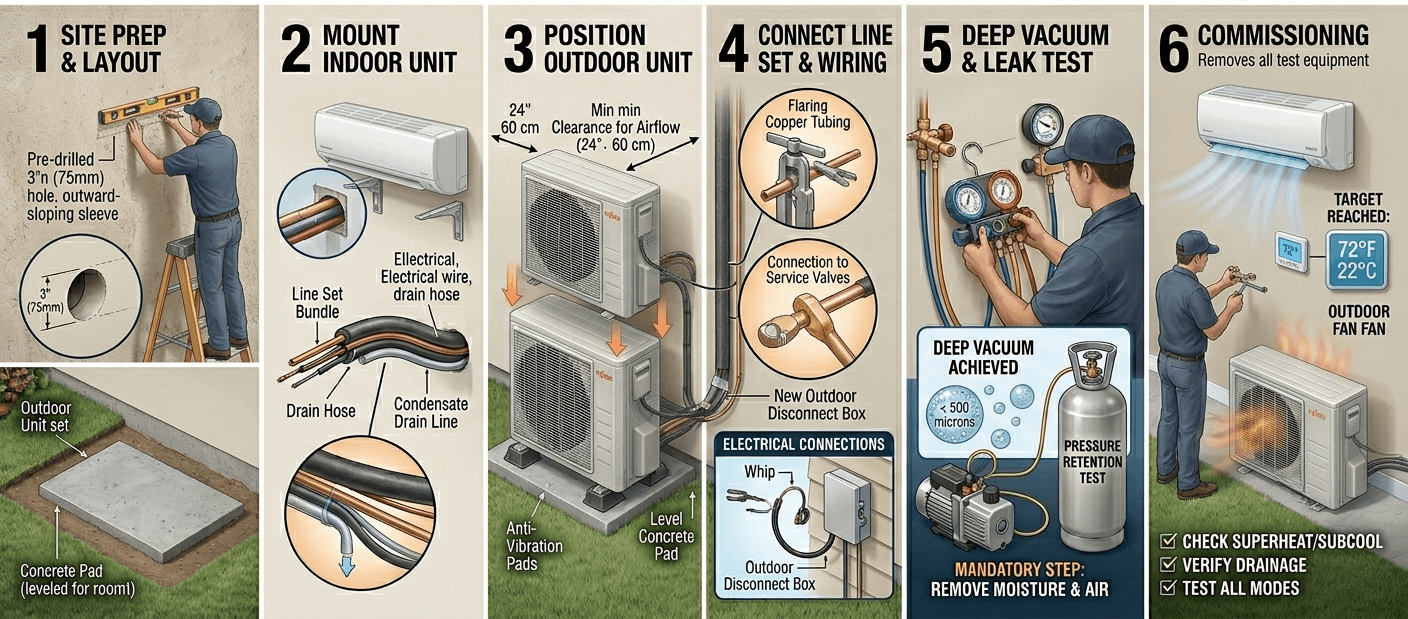
Portable air conditioners have a simpler installation process that costs much less than a fixed system. Installing a portable AC system requires connecting an exhaust hose that must be mounted to vent hot air out of a window. Most portable AC units come with a window-mounting kit that is easy to install. All you have to do is ensure that the supplied window mounting kit matches the window type in the room you are going to use the portable air conditioner.
Evaporative Air Cooler Installation
Evaporative air coolers are the easiest cooling systems to install. Most portable evaporative air coolers are plug-and-play right out of the box.
To start using an evaporative cooler, the following steps are generally required:
Fill water tray or connect to water supply.
Connect the cooler to the mains,
Leave a door or window open for ventilation.
Industrial evaporative air coolers may need professional installation due to the requirement of ducting and fixed placement.
Which Cooling Solution is Easier to Maintain?
Air Conditioner Maintenance
Whether you have a fixed air conditioning system or a portable AC unit, it is important to have it serviced regularly. Regular services can maximise energy efficiency. Improve the quality of the cooled air, prevent equipment breakdowns, and extend your air conditioner's lifespan.
Important components that require regular service include:
Component | Function | Maintenance Task |
|---|---|---|
Air Filter | Responsible for cleaning the air that moves through your air conditioning system. | Filters must be cleaned regularly and replaced periodically. |
Refrigerant | Responsible for absorbing heat from the air moving through the system. | Refrigerant levels must be checked regularly and refilled when low. |
Coils | Evaporator Coils – Absorb heat from your home. Condenser Coils – Vents heat out of your home. | Coils must be cleaned regularly. |
Condensate Drain | Provides an outlet for moisture absorbed by evaporator coils. Drains water out of your air conditioning system and away from your house. | Condensate must be drained regularly. |
Compressor & Fan | Compressor – Raises the refrigerant's temperature and pressure to trigger cooling. Fan – Moves outside air over cold evaporator coils. | The compressor and fan must be serviced regularly. |
Trained HVAC professionals must conduct all servicing and maintenance.
Evaporative Air Cooler Maintenance
Evaporative air coolers require less extensive servicing and maintenance than air conditioners. General maintenance includes:
Refilling the water supply (if it has a continuous water supply, check connection points).
Ensuring the water tank is cleaned.
Cleaning or replacing cooling pads.
Cleaning filters and vents.
Draining water when necessary.
Which Cooling Solution Is Best for You?
There isn’t one universally best cooling solution. Rather, the best cooling solution is dependent on your needs. If you need cooling in an enclosed, humid, or temperature-sensitive space, air conditioning is the best option. In dry, ventilated, or open spaces, evaporative air cooling is the best choice. For expert advice on which cooling solution is best for you, contact us to consult with one of our HVAC experts.
Choosing a cooling solution requires you to analyse your climate, building type, ventilation, and cooling expectations. Alongside those considerations, you also need to look at your budget. Some cooling options, like fixed air conditioning, have high upfront costs. For cooling on a budget, other options, such as cooling fans and evaporative air coolers, have lower upfront and running costs.
If you need help choosing the right cooling solution, check out the rest of our cooling blog articles. We have comprehensive buying guides for both air conditioners and evaporative air coolers. You can also head over to our cooling products section to compare products and see what matches your space, climate, ventilation needs, and budget.
Frequently Asked Questions About Air Conditioners and Evaporative Air Coolers
Are evaporative air coolers the same as air conditioners?
No. Evaporative air coolers use a different method to cool warm air than air conditioners. Air conditioners use refrigerant to absorb heat from indoor air, while evaporative air coolers pass hot air over cooling pads soaked in water.
Is air conditioning or evaporative air cooling better?
Neither is universally better. Air conditioning works best in hot, humid environments with little to no ventilation. Evaporative air coolers work best in hot, dry environments with a steady supply of fresh air.
Are evaporative air coolers cheaper to operate than air conditioners?
Yes, in most cases, evaporative air coolers are cheaper to operate in the long run. They have fewer components than air conditioners and use less electricity.
Which cooling system is best for a warehouse?
Evaporative air coolers are generally preferred for warehouses, especially in large, dry warehouses that are well ventilated.
Which cooling system is best for a bedroom?
Air conditioners are generally better suited for bedrooms as they provide stronger and more accurate cooling.
Which cooling system is best for an office?
Like bedrooms, offices require strong and consistent cooling. In this case, air conditioning is the best cooling solution for an office.